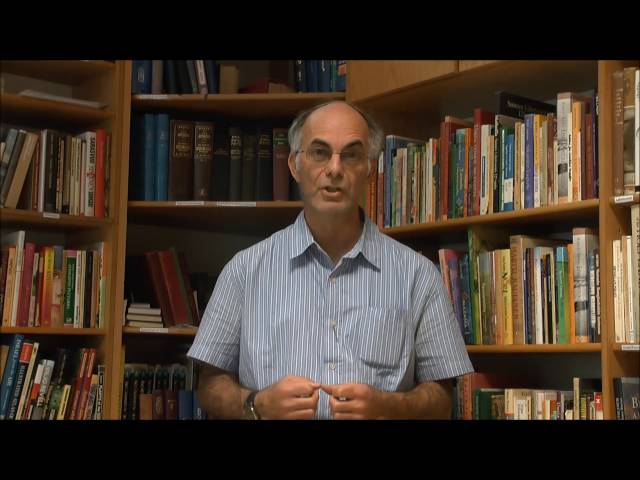
By Dr. Yehdua Stolov | Executive Director
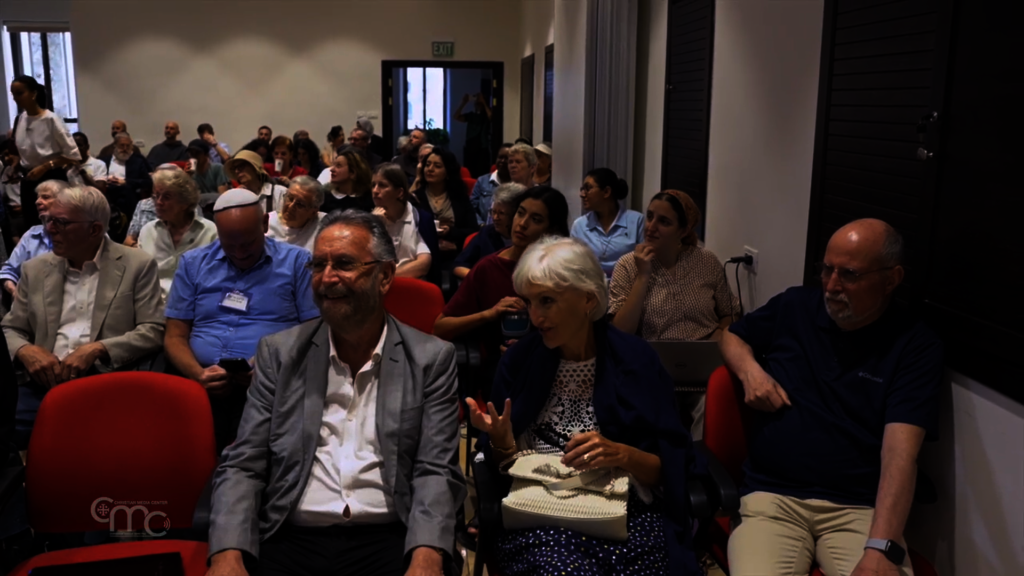
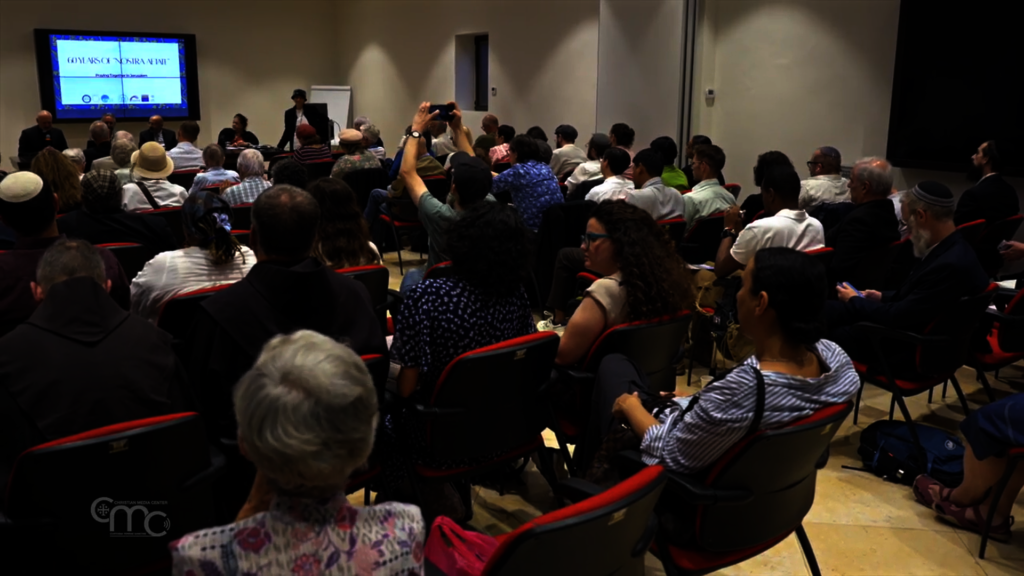
On November 6th, 2025, religious leaders and interfaith practitioners gathered at the Notre
Dame of Jerusalem Center to mark 60 years since Nostra Aetate , the landmark declaration
that transformed relations between faiths.
Together, they explored the origins of this document, its long-term impact in interfaith
relations, as well as accomplishments and challenges of the interfaith dialogue field in the
Holy Land, 60 years on.
The event was hosted by the Interfaith Encounter Association’s (IEA) Community Director,
Carolina Frimer, with greetings by Dr. Yehuda Stolov, IEA’s Executive Director.
Father John Paul delivered the opening remarks and shared one powerful visual example of
the change that Nostra Aetate brought, in the figure of “Ecclesia and Synagoga. Throughout
the Middle Ages, Church art showed Ecclesia strong and victorious, while Synagoga was
blindfolded and weak, unable to “see the truth.” But in the 1960’s, Jewish sculptor Joshua
Koffman was commissioned by the Church to create a new image – one that shows two
women standing side by side, learning from one another with dignity and mutual respect. A
vision of shared holiness instead of rivalry.
During the first panel, facilitated by Rabbi Dr. Naomi Dar, religious leaders discussed the
context, impact, and legacy of Nostra Aetate. Father Piotr Zelazko gave us the historical
context of the Second Vatican Council and its focus on positive global engagement being a
necessity in the emergence of the document. He elucidated how the long history of
“spiritual blindness towards Judaism…contributed to antisemitism,” and how the Shoah
forced the Christian and Catholic world to confront this crisis. Rabbi David Rosen recalled
the shift from Christian conversion of Jews, exemplified in his story of Theodor Herzl and
Pope Pius X, to the belief of Jews as a brother to Christians. Qadi Muhammad Abu Obied
stressed that this document cannot be the last motivator for interfaith relations. We must
do “practical deeds in order to bring Christianity, Judaism, and Islam toward more unity,
stability, and peace.”
At the end of the first panel, each religious leader offered their short prayers for peace and
understanding. Then, Hanna Yaffe and Ivor Lunzer presented the public with a powerful
rendition of Garth Hewitt’s beautiful song “Ten Measures of Beauty God Gave to the
World…”, and participants joined in the chorus asking us to “pray for the peace of
Jerusalem”.
During the second panel, representatives from different organizations discussed the
contemporary effects of the Nostra Aetate declaration, as seen from the field of interfaith
dialogue today.
Prof. Mohamad Dajani started by saying that “the Quran teaches respect for all the holy
books.” Peta Jones Pellach enunciated that the Nostra Aetate encouraged people to “stop
trying to make somebody believe as you believe, but actually to respect and honor the
difference.” She also told us about the Jewish Midrash of God throwing truth upon the
world, shattering it, in response to angels rejecting the creation of humans and how, as a
result, we can only ever understand one piece of truth at a time. With interfaith dialogue, we
can grow by gaining more pieces. Rabbi Sarel Rozenblatt said that the document invites us
to choose respect over intimidation, and there is still a lot of work to be done when we
reflect how our own communities engage with those who are different from us. Christina
Samara brought her experience in interfaith tourism as an example of interfaith dialogue in
practice, and commented that “we are more alike than we are different”, and ended by
adding that we should strive to surround our children with people from many backgrounds,
so that they won’t feel so different from other groups.
The event also included an interactive study session led by Reverend Geert de Korte, in
which participants read excerpts from the Acts of the Apostles and from Nostra Aetate, and
discussed how the declaration sheds new light on the interpretation of certain scriptural
passages.
The closing remarks were delivered by Rabbi Dr. Shlomo Dov Rosen and participants shared
dinner together.
Links:
Project reports on GlobalGiving are posted directly to globalgiving.org by Project Leaders as they are completed, generally every 3-4 months. To protect the integrity of these documents, GlobalGiving does not alter them; therefore you may find some language or formatting issues.
If you donate to this project or have donated to this project, you can receive an email when this project posts a report. You can also subscribe for reports without donating.



Support this important cause by creating a personalized fundraising page.
Start a Fundraiser