By Jennifer Schechter | CEO and Co-Founder
Integrate Health Open House in Togo
Integrate Health hosted our first Open House in Lomé on March 10th. The purpose of the Open House was to increase the visibility of Integrate Health’s work—in particular the impact of the Integrated Primary Care Program—and to garner support for Universal Health Coverage (UHC) reforms grounded in community health.
The Open House started with a plenary session and included speeches from the mayor of Lomé, the World Health Organization representative in Togo, and a village chief from the Binah district. After that, over 200 attendees participated in an exposition and had the opportunity to speak directly with Integrate Health staff, including Community Health Workers (CHWs). Two panel discussions entitled “Digital Health: Practices and Perspectives" and "Achieving UHC: Gender and Community Healthcare" generated significant interest among the public, with participants actively engaging in the discussion. Finally, IH organized a workshop for graduate students in journalism to train the next generation of Togolese journalists to report on community health and UHC.
The Open House was well received and was featured by multiple Togolese news outlets such as Togo Top News and Togo Breaking News. Overall, the Open House succeeded in shining a light on Integrate Health’s activities in Togo, effectively bridging a longstanding visibility gap. Policy makers, members of the academic community, journalists, implementing partners, and district health authorities all answered the call, demonstrating that primary healthcare, community-based care, and UHC are areas that mobilize key stakeholders in Togo. The Open House ended on a festive note with dancing to celebrate a successful day!
Program Highlights
Successes
Handover of the Integrated Primary Care Program in Kozah: In February, Integrate Health and the Kozah district health authorities co-hosted an official launch ceremony celebrating the start of the transfer of the implementation of the Integrated Primary Care program from Integrate Health to the district health team. The ceremony brought together government health officials, political leaders, health workers, Integrate Health leadership, and community representatives. The discussion was lively, and community members asked thoughtful questions about the district health team’s plan to continue consultations with the community with regards to program decision-making and to ensure the same quality of service provision as Integrate Health. These are important questions that will be addressed by the district and Integrate Health teams together through the transfer process.
Ultrasound Program: In late 2021, the Kara regional health department of the MOH requested Integrate Health’s support in scaling our ultrasound program to the entire Kara region. The regional program, which pilots task-shifting of obstetric ultrasound screening to trained midwives, launched in May 2022 (more information about the launch can be found on Integrate Health’s website here). Integrate Health and the MOH completed a joint evaluation of the program in January 2023 and found that while there were a few challenges related to logistics, the program dramatically increased access to a lifesaving screening and ensured high-quality care. During the implementation period, 4,171 women were reached with a lifesaving ultrasound screening, one that was unavailable before the program. Quality of service was maintained with physicians at the referral hospital confirming 87% of diagnoses made by midwives. Ultimately the ultrasound program demonstrates that it is feasible and effective to task-shift a critical component of quality maternal care from specialists such as radiologists, obstetricians, and gynecologists to midwives.
This impactful program must be further strengthened in order to reach all 37,000 estimated pregnant women in the Kara region. Integrate Health is working with the MOH and funding partners to procure additional ultrasound machines and train more midwives. In addition, MOH representatives, including the regional health director and chief of obstetrics at the Kara University Hospital who helped design this program, hope to use the future results of the program to inform changes in the national policy and training curriculum.
Challenges
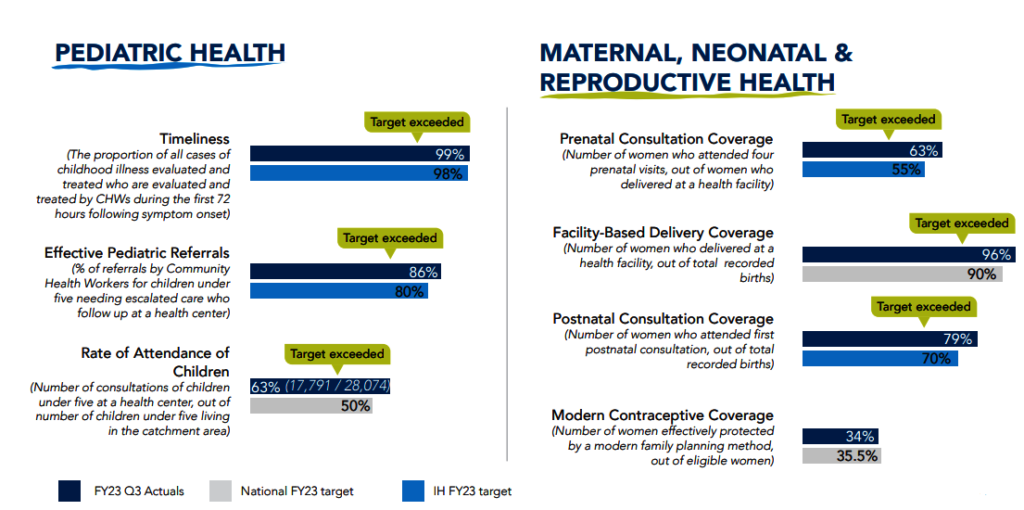
Modern Contraceptive Rate Reporting Errors: Integrate Health continues to experience challenges in data collection methods for family planning (FP) indicators in the Kéran district. Data entry errors were identified in Kéran in January 2023 and February 2023, and the Monitoring, Evaluation, and Quality Improvement (MEQI) team worked with health center staff to correct these errors. After corrections were made, the modern contraceptive rate dropped from 39% (average of rates between April 2022 and September 2022) to 26% (average of rates between October 2022 and March 2023). While the corrected number is lower, the MEQI team believes that it is a more accurate measure of the modern contraceptive rate in Kéran.
In general, the modern contraceptive rate has proven particularly difficult to calculate because the indicator is tracked through physical FP cards and requires follow up since FP methods last over time. In addition, there is a more complicated process for data entry. For example, for FP, health centers must combine data from both CHWs and health centers, and this is an extra step not required for many other indicators.
Solving this challenge involves close collaboration between Integrate Health’s MEQI team and the clinical mentors who also serve as peer coaches to health center staff, and Integrate Health continues to work with health centers to modify their workflow and follow the correct procedures for data entry in line with the MOH requirements.
Expansion Highlights
Successes
Adaptation of the Integrated Primary Care Program for Guinea: A team of program staff members from Togo have been meeting weekly with Guinea staff since February to review and adapt the implementation guide for the Integrated Primary Care Program to the Guinean context. This ongoing process has resulted in deep knowledge sharing across the two teams and has also highlighted areas where further insights and clarifications will be needed in order to finalize the guide and ensure effective program implementation in the Guinean context.
Use of Digital Tools in Guinea: In Guinea, the MOH’s Expanded Program for Immunization invited partners to present their experiences using digital tools for immunization delivery to inform development of the national strategy for digitizing immunization data. Integrate Health’s Country Director in Guinea, Dr. Aboubacar Diakité, presented the Tonoudayo application, which was recently piloted in Togo, and shared lessons learned. A primary feature of the tool is the vaccine reminder function, which sends reminder messages to CHWs who inform parents of their children’s immunization schedules. The audience, including international organizations, national NGOs, and MOH representatives, expressed enthusiasm about this feature and interest in working with Integrate Health on digital health initiatives. This presentation was a great opportunity for Integrate Health to demonstrate our expertise and to work with other organizations.
Organizational Highlights
Successes
Strategic Planning Process: In March, Integrate Health successfully completed a two-day strategic planning retreat in Togo with a 12-member strategic planning commission, a representative body of staff from all levels of the organization who oversaw the strategic planning process. The retreat was also attended by Integrate Health’s Senior Leadership team and members of the LSS Global Consulting group, who were hired to facilitate the strategic planning process. The retreat was the culmination of work that started in December 2022, which included over 50 stakeholder interviews and focus group discussions. At the end of the retreat, a new theory of change was adopted, which will be the cornerstone of the new five-year strategic plan for Integrate Health. We look forward to launching our new theory of change and 2023-2028 strategic plan to our donors and partners in July 2023.
Program Evaluation Training: In early February, 23 staff members from the MEQI, Research, Program, and Clinical Innovation teams in Togo participated in a three-day training on project/program evaluation. Thanks to support from Rippleworks, Integrate Health has made significant investments in professional development opportunities for staff, including this training. Using the example of the recently scaled ultrasound program and additional practical exercises, key concepts of evaluation were explained including evaluation typology and process, indicator development, self-evaluation vs. external evaluation, and how to structure an evaluation plan.
Challenges
FY24 Budgeting Process: Integrate Health’s five-year strategic planning process was delayed for approximately three months because we faced significant challenges in identifying qualified, affordable, French-speaking consultant teams. Once the process started, with LSS Global taking the lead, the planning process progressed smoothly. The 2023-2028 strategic plan is on track to be completed in early May. This delayed strategic planning timeline led to an expedited timeline for the budgeting process for the coming fiscal year, FY24 (July 2023–June 2024). The finance and leadership teams worked hard to draft budgets and operational objectives and key results in less than a month. The teams were able to meet their deadlines, and the new budget will be ready for presentation at the next Integrate Health board meeting in May 2023.
CHW Spotlight: Lami Pafaliki
Lami Pafaliki has been with Integrate Health since 2021 when the Integrated Primary Care Program was launched in the Binah district and is currently one of 40 CHWs in Binah. Around the world, CHWs provide care to millions of patients, removing barriers to care and treating diseases, but their efforts often go unrecognized. Lami sees herself as a link between her community and the local public system and advocates for more recognition of the work of CHWs. For Lami, “being a CHW is not a vocation, but a carefully thought-out choice,” and she has dedicated her efforts to providing primary healthcare to her community.
In March, Lami participated in the 3rd Annual CHW Symposium held in Monrovia, Liberia. Lami was one of more than 700 delegates from 46 countries, all from various organizations including MOHs, universities, the private sector, and development partners, who made the trip to Monrovia. Lami spoke on a CHW-led advocacy panel, during which she shared her experience working as a CHW in Togo. Lami joined in the powerful call to action: “Nothing about us, without us.”
"All of these CHWs who made the trip to Monrovia not only share strong visions but also work daily to set an example that they are true heroes in [determining] the health of tomorrow. I left Monrovia satisfied with the exchanges at various levels but also with the hope that with the continued commitment of all major players like my organization, Integrate Health, the Monrovia call will be implemented at various levels."
Financial Highlights
Links:
Project reports on GlobalGiving are posted directly to globalgiving.org by Project Leaders as they are completed, generally every 3-4 months. To protect the integrity of these documents, GlobalGiving does not alter them; therefore you may find some language or formatting issues.
If you donate to this project or have donated to this project, you can receive an email when this project posts a report. You can also subscribe for reports without donating.



Support this important cause by creating a personalized fundraising page.
Start a Fundraiser