By Rosy Nimroody | Communications Officer
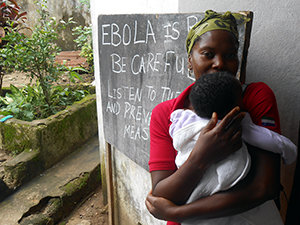
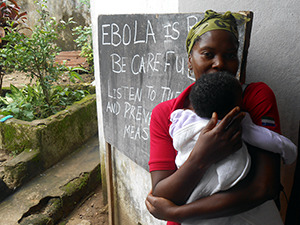
Save the Children has had a strong presence in West Africa for years. We are working around the clock to help stem the spread of the Ebola virus and check its catastrophic impact on children and their families. Our staff played a vital role from the onset of the epidemic in bolstering community engagement in affected regions – a factor which is now thought to be a major reason behind the improving situation in Liberia. We are grateful to our brave staff who join other Ebola fighters in earning Time Magazine's Person of the Year in 2014.
As the nature of the epidemic changes, so must our response approach. Save the Children is working now to contain sporadic outbreaks that are occurring in hard to reach remote communities in the affected countries. In Liberia, we will continue to identify, triage, test and refer patients to beds in Ebola Treatment Units (ETUs) through our two Community Care Centers (CCC).
We will also transform our static CCC model to a more nimble one that will bolster surveillance and contact tracing, and will develop Case Investigation Teams to respond swiftly to individual outbreaks by setting up isolation units, mobile labs and rapid referral mechanisms. We will look to use simple rapid response structures such as pop-up tents that will enable us to concentrate on more active case finding in hot zones to test and triage probable cases quickly.
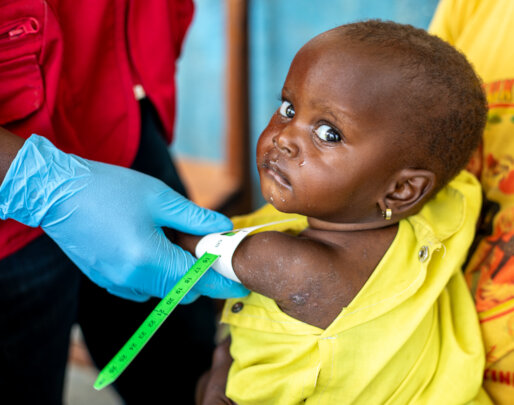
Our three-pillar strategy to combat Ebola aims to reduce transmission and provide access to life-saving care, restore and strengthen health systems to increase access to treatment for non-Ebola conditions, and mitigate impact on essential services (child protection, education, nutrition, food security and livelihoods) by rehabilitating essential infrastructure and systems.
Liberia:
In Liberia, the two ETUs we built (in Bong and Margibi), which are now managed by International Medical Corps (IMC), continue to treat patients in isolation wards and provide expert medical care and treatment. In Margibi, our two CCCs (in Dolo Town and Worhn) help contain transmission. We continue to train community health workers and traditional midwives on infection prevention and contact tracing; provide health care facilities with urgently needed medical supplies; set up hand-washing stations at health facilities; and supply food and water to Ebola patients. We have also rehabilitated and supplied transit centers for children and helped identify foster families to care for children. New developments include:
Sierra Leone:
In <a "href="http://www.savethechildren.org/site/c.8rKLIXMGIpI4E/b.9206809/k.95FB/Sierra_Leone.htm">Sierra Leone, Save the Children continues to manage the 92-bed Ebola Treatment Unit in Kerry Town with over 500 frontline medical staff and provide staff in primary health clinics with supplies and training for infection prevention and control. Our staff has led the scaling up of child registration and family tracing and reunification activities. We also provide psychosocial counselling and reunification packages, including food and clothing, to children who return to their families or to an alternative caregiver and secure financial support, as well as toys, clothes and food, to interim care centers for unaccompanied and orphaned children. New developments include:
Guinea:
In <a "href="http://www.savethechildren.org/site/c.8rKLIXMGIpI4E/b.6150371/k.C79D/Guinea.htm">Guinea, we continue to train health workers, volunteers, Ministry of Transport workers and teachers on Ebola prevention and protection messages; conduct general awareness raising and radio programs; support community health workers with contact tracing; provide protection kits (soap and other supplies) to health centers, schools, public services and transportation stations; and provide psychosocial, nutritional and social support for children whose families have been affected by Ebola. New developments include:
Mali:
In <a "href="http://www.savethechildren.org/site/c.8rKLIXMGIpI4E/b.6150453/k.B24A/Mali.htm">Mali, we continue to support contact tracing following the six cases of Ebola here. We trained our staff to implement infection prevention and control, and procured protective and sanitation equipment for health centers and other public facilities. Community-focused messages for media, health workers, schools and other community stakeholders will be translated into local languages and disseminated.
How You Can Help
Please support Save the Children’s global mission. Your tax-deductible gift gives children in the U.S. and around the world what every child deserves – a healthy start, the opportunity to learn and protection from harm. When disaster strikes, we put children's needs first. We advocate for and achieve large-scale change for children. We save children's lives.
Please keep children in your thoughts for a bright new year.
http://www.globalgiving.org/projects/save-the-children/
Have a wonderful holiday. Thank you again for your support.
Happy New Year!
Project reports on GlobalGiving are posted directly to globalgiving.org by Project Leaders as they are completed, generally every 3-4 months. To protect the integrity of these documents, GlobalGiving does not alter them; therefore you may find some language or formatting issues.
If you donate to this project or have donated to this project, you can receive an email when this project posts a report. You can also subscribe for reports without donating.