By Soni KC | Project Leader
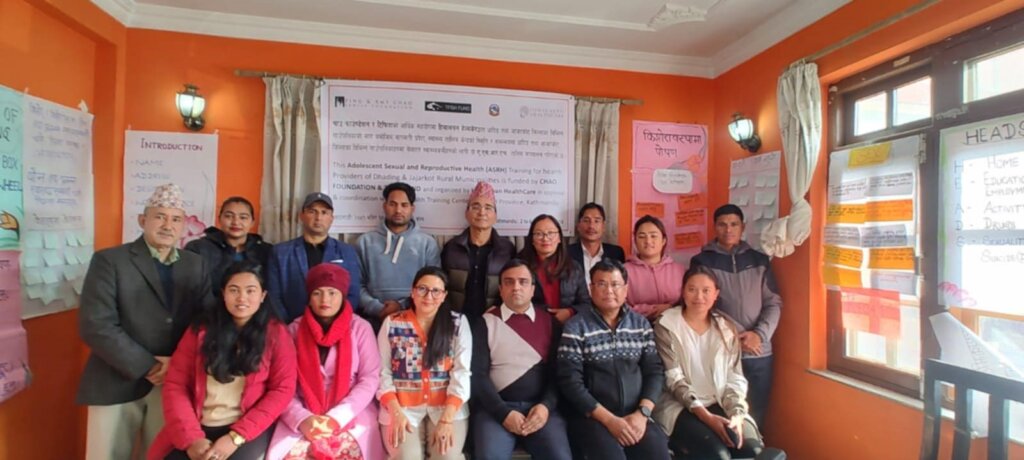
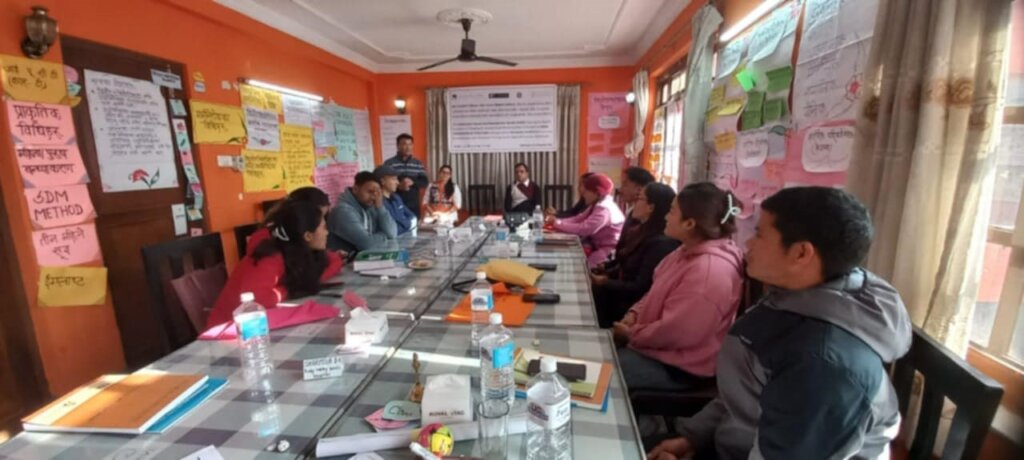
Himalayan HealthCare (HHC) with financial support from Chao Foundation carried out 5 days Adolescent and Sexual Reproductive Health Training to 10 government health providers of 5 rural municipalities of Dhading and Jajarkot districts. The training was held at HHC office in Kathmandu from 2 to 6 December and was conducted by lead trainers Ms. Jamuna & Dr. Bijay from Marie Stopes and Mr. Basant from Bagmati Province Health Training Division.
The main objective of the training was to increase the availability and access to information about adolescent health and development, and provide opportunities to build skills of adolescent service providers, to increase accessibility and utilization of adolescent health and counselling services for adolescents, and to create safe and supportive environments for adolescents in order to improve their legal, social and economic status and rights.
Adolescence is the period of transition from childhood to adulthood. In this stage, various physical and psychological developments occur. It is also the transition period from puberty to legal adulthood. The UN define adolescents as the 10-19 year old (early adolescence 10-14; late adolescence 15-19), among youth: 15-24 year old. Sexual and reproductive health (SRH) is a state of complete physical, mental and social wellbeing in all matters relating to the reproductive system. It implies that people are able to have a satisfying and safe sex life, the capability to reproduce, and the freedom to decide if, when, and how often to do so. Sexual and reproductive health rights (SRHRs) are human rights. The right to sexual and reproductive health implies that people are able to enjoy a mutually satisfying and safe relationship, free from coercion or violence and without fear of infection or pregnancy, and that they are able to regulate their fertility without adverse or dangerous. Adolescent sexual and reproductive health (ASRH) is a healthy state in terms of the system, function and reproductive processes of a teenager.
Topics covered during the training:
Sexual and reproductive health rights
Value clarification on ASRH
Effective communications
Psychosocial counselling for adolescents
Changes in characteristics in adolescents (physical, mental, hormonal, and sexual)
FP methods for adolescents (discussion of suitable FP methods for adolescents)
Human Sexual orientation, and discussion on sex, sexual and sexuality
HIV aids, STIs/RTIs services to adolescents
Mental health for adolescents
Nutrition for adolescents
Discussion update data
Record/reporting system of adolescent services
QI tools and certifications of adolescent-friendly sites
Methods of Training:
Power point presentation (PPTs)
Standard guidelines and required job aids with complete sets of manuals
Required handouts of updated data
Many real case studies and role plays in specific conditions
Preferential and multiple-choice questionnaires
Varieties of group activities in different contents session-wise
Varieties of family planning methods with the complete set of family planning choice kit box, medical eligibility criteria wheel (MEC), DMT tools
BP measuring sets, thermometers, pulse oximeters,
Varieties of standard stationary materials for different activities, like newsprint, meta cards, sticky notes, markers, highlighters, etc.
Outcome of Training:
The participants were evaluated pre- and post-training by the trainers. The pre-training evaluation was to assess their existing knowledge and skills and to help identify areas that need improvement so that the right training can be designed. The pre-training score was in between 35% to 65% whereas the post training score was 85% to 100%.
All the trainees (health providers) were competent in the ASRH content, and they developed the action plan to be implemented immediately in their respective health posts.
The ASRH training was successfully conducted and fulfilled the training objectives and achieved the participant’s expectations as well.
Project reports on GlobalGiving are posted directly to globalgiving.org by Project Leaders as they are completed, generally every 3-4 months. To protect the integrity of these documents, GlobalGiving does not alter them; therefore you may find some language or formatting issues.
If you donate to this project or have donated to this project, you can receive an email when this project posts a report. You can also subscribe for reports without donating.



Support this important cause by creating a personalized fundraising page.
Start a Fundraiser