By Fidaa | Mercy Corps WASH Program Officer
In my heart, I belong to the people of Gaza. Whenever I go on field visits in the community, I feel a strong sense of belonging to the people. During water deliveries, I feel connected to the little girl struggling to carry a jerrycan and to the elderly woman trying to hold two cans at once to support her family. I may live a better life than many people here, but I belong to those who have almost nothing. I always wish I could do more.
I have been on the Mercy Corps team since 2022. About a year ago, I joined the WASH (Water, Sanitation, and Hygiene) team, delivering clean water, sanitation, and hygiene support across Gaza. Water is one of the biggest challenges in Gaza. That is why I chose to specialize in water resources management. I wanted to help create real solutions that would give families access to clean water—to address the same needs I knew so well from my own childhood here.
I was born and raised in Khan Younis in the southern part of the Gaza Strip. The only time I lived outside Gaza was during my year in the United Kingdom while completing my master’s degree. My family is originally from a village called Karatiyya, and was eventually displaced in 1948. My great-grandfather fled to the Gaza Strip, and my family lived in a camp in Khan Younis. Camp life meant overcrowded housing, poor infrastructure, and daily struggles with water and sanitation.
At the camp, we received access to water only one day each week. That single day shaped our entire routine. We had to pump the water to the roof tank, ration it, and make sure it lasted until the next week. There was no functioning sewage network either. These daily problems were part of my childhood and shaped my understanding of how important water and sanitation truly are.
Water is essential
Even before the war, the water system was fragile. Since the war, most of what remained has been devastated. Recent estimates show that around 80% of water and sanitation infrastructure in Gaza has been destroyed, including desalination plants, water networks, wells, and wastewater systems. More than two million people now depend on the remaining 20% of infrastructure.
You can see the consequences everywhere. Sewage water flows in the streets. Children play next to wastewater because it has become part of daily life. This is not only about drinking water. People struggle even to find one liter of water for basic use, including washing or toilets. People need water, sanitation, and the minimum to survive.
Our mainwatersource is the coastal aquifer—the groundwater reservoir near the Mediterranean Sea—and the sea itself, which gives us the possibility of desalination. As I've gained experience, I realized that water in Gaza is primarily a political issue. The scientific and technical solutions already exist, but political constraints prevent us from applying those solutions at the scale that is needed.
People need water, sanitation, and the minimum to survive.
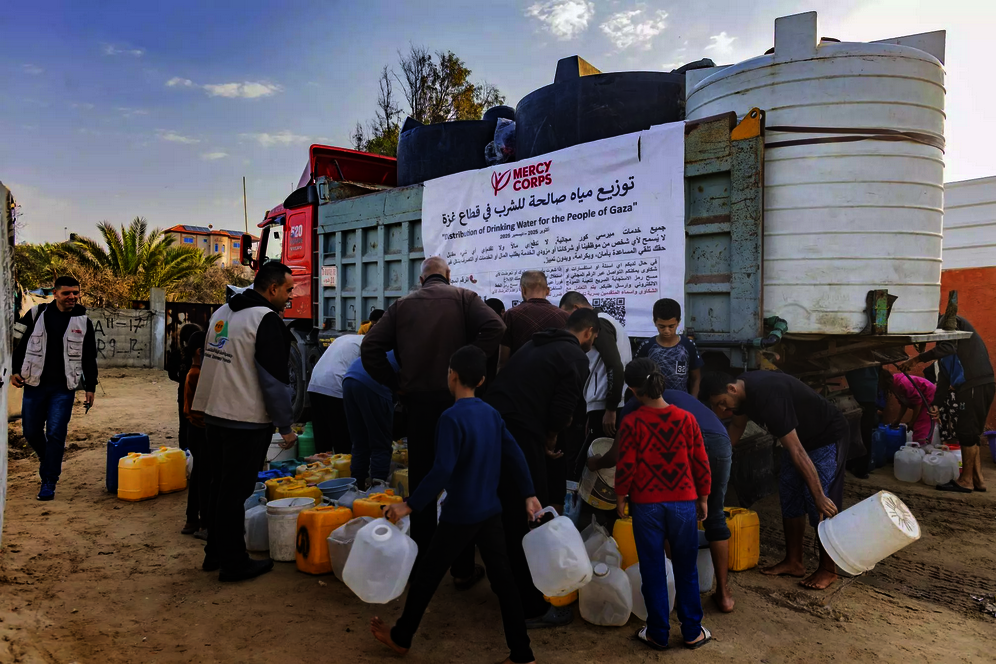
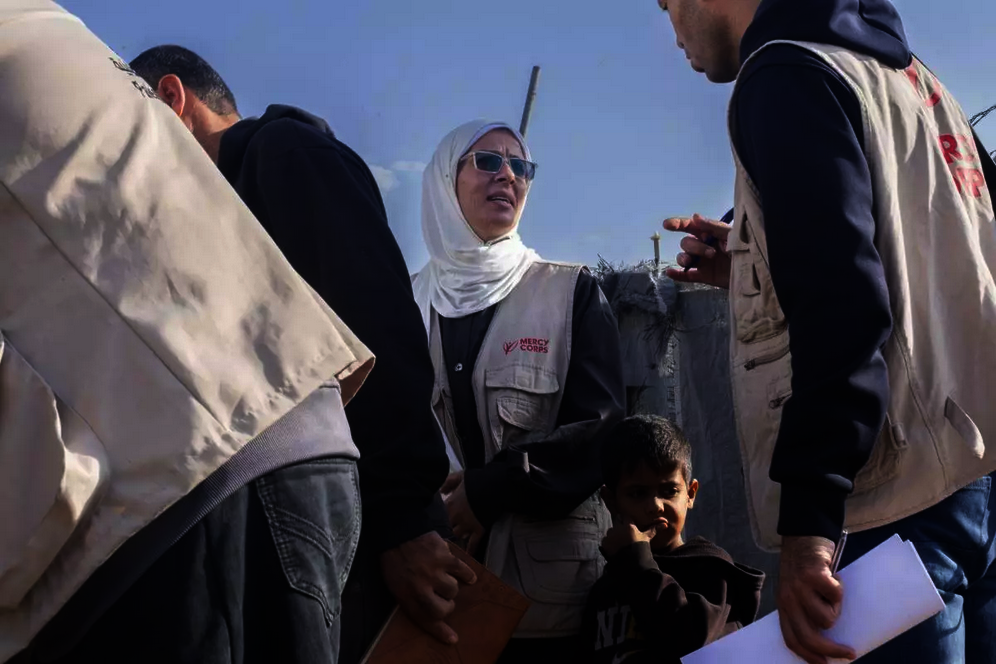
In my current role, I lead and coordinate WASH activities, which include overseeing water deliveries to camps for displaced people. Since June 2025, we’ve delivered clean, safe drinking water to ten sites across seven camps, reaching about 800 families each day.
We work closely with camp leaders and send SMS messages to all residents with delivery schedules and a hotline number. All the water trucks include banners with information about the program with the same hotline where participants have provided useful feedback on how we can best get clean water to their communities.
We had been preparing to expand our water deliveries across Gaza. We had also planned on building latrines and providing support for managing solid waste. But everything was canceled due to foreign aid cuts.
For water trucking, we rely on very limited private funds. The scale is still tiny compared to the need. Our plans were much larger, and people deserve much more support.
In every camp we serve, we learned that people were travelling long distances to reach a desalination plant or any place where they could fill a container. We currently rely on one of three public desalination plants in Gaza, which was designed to serve people in Rafah and Khan Younis, but is now providing water far beyond its intended capacity. It supports 70 water trucks every day.
For water trucking, we rely on very limited private funds. The scale is still tiny compared to the need.
If Mercy Corps stopped trucking water, families would have to return to walking long distances every day just to collect a small amount of water. Some families walk about a half-mile to fill a single jerrycan, which is very heavy when it’s full. In many households, it is the children who collect the water. It is heartbreaking to see young children carrying containers that weigh more than they do. These children should be in school. They should be playing. They should not be responsible for struggling to bring water home for their families.
Need is everywherePeople do not have enough water or enough food. They do not have a stable income. Many people lost their shops, their jobs, and their entire livelihoods. They lost everything, truly everything. The need is everywhere.
People are living in extremely small spaces, maybe 200 square feet, surrounded by blankets or tarps. Inside that tiny space, they designate a small area to be the toilet, usually a shallow pit in the ground. Families who are in slightly better conditions try to create simple systems using a small pipe or a hose to direct the wastewater outside the tent. Even then, the smell inside the tents is overwhelming. I still do not understand how people manage to sleep or eat in that environment. But they do, because they have no choice.
Gaza is my home
It is very painful. Before the war, I always said I would never leave Gaza. As long as Gaza existed, I would stay. When I lived outside Gaza while studying in the U.K., I knew I would return. I am Gazan, and Gaza is my home.
That is why I had built my house here. Some people left Gaza because they could not endure the suffering, but that was never my plan. I wanted my children to grow up among their own people. I wanted them to understand our history and our struggle so they could carry it with them. We have one land, and this is it. Even if we travel and find better opportunities elsewhere, it will never be our country. Palestine is our country.
For me, this is the hardest part. I am here because I want to help. I believe in staying with my community. But I often feel that I am not helping enough. Even so, I feel genuinely happy when I see families collecting safe drinking water from the trucks. Helping people has always been my favorite part of my job. So, I will continue showing up every day for my people and my country.
Project reports on GlobalGiving are posted directly to globalgiving.org by Project Leaders as they are completed, generally every 3-4 months. To protect the integrity of these documents, GlobalGiving does not alter them; therefore you may find some language or formatting issues.
If you donate to this project or have donated to this project, you can receive an email when this project posts a report. You can also subscribe for reports without donating.



Support this important cause by creating a personalized fundraising page.
Start a Fundraiser