![Recreation services]()
Recreation services
Implemented in the city of Dire Dawa, this project is the continuation of previous programs that have made it possible to transfer care for street children to the communities in section 6 and 4 of Dire Dawa (with links with the city's social services). It now aims to consolidate and expand the activities of community organizations to improve the living conditions of vulnerable children in section 5, which is among the poorest sections in Dire Dawa.This project, like all the projects supported by Secours Catholique – Caritas France, is implemented for the benefit of all communities, regardless of their obedience.
CONTEXT
Ethiopia is the second largest country in Africa in terms of population and twice the size of France. Ethiopia is a secular federal state that shares borders with Somalia, Sudan, South Sudan, Kenya, the Republic of Djibouti and Eritrea.
Considered as one of the cradles of humanity, Ethiopia is one of the oldest areas of human settlement and the second oldest Christian (Orthodox) nation in the world. Despite sustained economic growth over the past 10 years and government efforts to improve access to basic services, Ethiopia is the 6th least developed country in the world.
The most significant factors and problems in the country are: very strong population growth, high land pressure and access to land, recurrent droughts and conflicts with Eritrea and Somalia. The population is highly vulnerable to unpredictable weather conditions and fluctuating prices on international markets for export commodities such as coffee.
Finally, the political situation in Ethiopia is complicated: in 2015, anti-government demonstrations were severely suppressed and hundreds of people died. In 2016, a state of emergency was declared for 6 months following a week of violence in the Oromia region (a few kilometers from Addis Ababa).
Yet the potential of this country is real. Better mobilizing and protecting existing natural resources, supporting the entrepreneurial spirit of poor people and increasing access to basic services are high priorities for us in Ethiopia.
With an estimated population of 234,000, Dire Dawa is Ethiopia's second largest city. Located 515 kilometers east of Addis Ababa and 350 km from Djibouti, it is on one of the country's largest trade routes. 45% of the population lives below the absolute level of poverty. The population is growing faster than the national average due to a high birth rate and high immigration (56% of the population is under 19 years old). It is the focal point of Somali, Oromo and Harari regions, close to the republics of Somalia and Djibouti, and lives on trade, the black market and smuggling of manufactured products, fruit and vegetables, and coffee. The city is experiencing a severe economic crisis due to the government's fight against illegal trade and the bankruptcy of local industries and railways, which are the mainstay of the local economy. The first victims of this impoverishment are children, and today there are 18,000 orphans and vulnerable children (OVCs) in Dire Dawa, a rapidly growing number.
A first program was carried out from 2000 to 2005, focusing on services provided to 254 street children and services and community mobilization in one of the most vulnerable districts of the city (downtown, market, bus terminal, etc.). Building on this experience and at the request of district communities, a new program (2007-2009 extended to October 2011) has enabled children and their families to raise awareness of HIV/AIDS and personal hygiene issues, with 333 vulnerable children in district 6 of Dire Dawa (out of 1,900 children in the section), the creation of an autonomous community organization dedicated to vulnerable children in the district.
At the end of the project in 2011, an evaluation demonstrated the relevance of active community participation in the management of these orphans and vulnerable children (OVCs).
Between 2012 and 2014, a new project was also carried out in the Kebele 04 district, thus continuing the previous program in the city of Dire Dawa. Of the 300 OVCs cared for (including 150 street children), nearly 93 per cent were enrolled in school and almost 40 received vocational training.
PROJECT PRESENTATION
This project aims to extend the scheme implemented in district 4 and 6, to the Kebele 5 district of Dire Dawa and to encourage associations to develop their own activities independently from the initial phase of project implementation.
OBJECTIVES
Global: Contribute to strengthening and expanding the response of community organizations to improve the lives of poor and vulnerable children in Dire Dawa's Kebele 5 district.
Specific:
- The health situation of 300 OVCs is improved;
- The school level of 300 vulnerable children is improved;
- The psychosocial well-being of 300 vulnerable children is improved;
- The partnership and collaboration system is improved;
- 300 children have acquired valuable skills and are financially independent.
- Social mobilization and community empowerment make it possible to envision sustainable community ownership of OVCs.
BENEFICIARIES
Direct: 300 vulnerable children distributed as follows:
- Orphans of parents (33%)
- Orphans of both parents (22%)
- Children living totally on the street (20%)
- Street children (children partially living on the street) (25%)
- 100 parents/guardians will benefit from an income-generating activity (microcredit).
Indirect: community members in general and local partner organizations.
PROJECT ACHIEVEMENTS
Objective 1: Improving health situation of OVC
- Result 1.1: Provision of laundry soap and sanitary materials / using showers and laundry services. 324 children (250 on the street and 74 of the street) have received a bar of soap 3 times per month for using showers and laundry services. In addition, 95 adolescent girls have benefited of 1 sanitary pad per month for their personal hygiene. The showers and washing basin area have been renovated by the project. They have been used by 74 of the street children after work on a daily basis and by 155 on the street children usually after recreation.
- Result 1.2: Provision of health education. A nurse has been hired to provide preventive health education on a weekly basis. 221 on the street and 66 of the street attended the sessions organized in the center.
- Result 1.3: Getting medical support and medical treatment for sick children.A contractual agreement has been renewed for the year period with a government health center for the provision of medical treatment. 63 on the street children and 3 of the street children get a medical treatment at the health center.
Objective 2: Improving the level of formal education of OVC
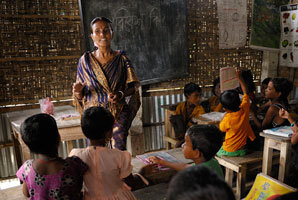
- Result 2.1: Provision of scholastic materials and school uniforms. School uniforms have been distributed to 250 of the street children attending formal schools. Education materials have been distributed to 250 on the street children but also to 74 of the street for their basic education provided in the center.
- Result 2.2: Implementation of Tutorial classes support. Tutorial classes have been arranged out of school time for students from grade 1 to 8. They are performed by 6 experienced teachers working in public schools (2 hours per day and 3 days a week). In the reporting period, tutorial classes have been organized for 152 on the street children attending academic schools. And 74 of the street children who are out of the school system, received a basic training (reading, writing, counting) provided by the social workers and part-time by tutors for a period of 8 days per month.
- Result 2.3 : Organization of Library service. This service was not accomplished as defined in the project, due to unavailability of convenient reading rooms at the project center. However, with the collaboration of a public school library, this service has been provided to 242 direct and indirect beneficiaries.
- Result 2.4 : Provision of educational awards. Based on the report made at the end of 2018 academic year, 229 by 250 students (92%) on the street were able to access to the next grade level. The 40 best students having 1st-3rd rank in their respective classroom have been recognized with a ceremony award.
Objective 3: Improving the psycho-social wellbeing of OVC
- Result 3.1 : Provision of psychosocial counseling. The psychologist hired by the project has organized group-counselling sessions once a week for 274 targeted children. These sessions were focused on establishment of good family relationship, development of self-confidence and self-esteem, and interpersonal communication.
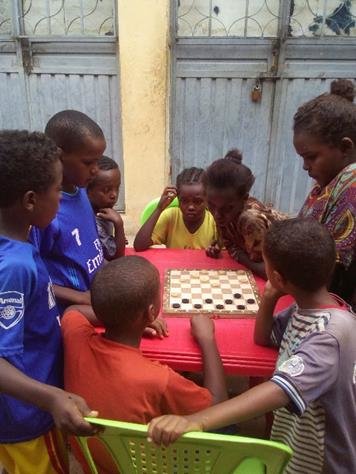
- Result 3.2: Organization of indoor and outdoor activities and recreation services. Indoor activities include recreational films, chess and dominoes and outdoor activities are mainly sport as tennis table, soccer and volleyball. Beside this, music, cultural dance and drama training have been provided to 74 children by a community volunteer service provider. A total of 277 children have benefitted of these activities.
Objective 4: Improved system of partnership and collaboration with key stakeholders
- Result 4.1: Services are provided to children in an integrated manner through coordination and networking of actors in the sector in order to promote the exchange of experience, best practices and avoid duplication. But trainings and awareness raising workshops have not been performed in 2018 because of 2 mains reasons:
- The search of a new location for the social center.
- The selection process of one CBO[1] to take the lead of the project after 2019.
So the discussions with the key stakeholders were focus on these two challenges. The trainings will be organized in 2019.
[1] A CBO is a Community Based Organization composed of people/families of the Kebele. For example, IDDIRS have a strong presence in the community in each Kebele. Traditionally, IDDIRS are funeral associations taking care of the families living in the same neighborhood. Recently, the role of IDDIRS has been extended from burial to the promotion of social welfare and local development management
Objective 5: Getting marketable skills and capabilities to be self-employed / and improving the economic condition of OVC families/guardians
- Result 5.1: 75 children have gained technical skills (in mechanics, wood work, metal work …) and entrepreneur skills at the completion of the training sessions. In the reporting period, 25 children (16 of the street and 9 on the street children) have been trained on wood work (9 children), metal work (2 children) and vehicle maintenance (14 children). The training sessions were given in collaboration with private firm owners for 6 days per week for the period of 1 year (from Sept.2017 to Aug. 2018). After the completion of their vocational training, 25 children have received a 2 days training on entrepreneur skills mainly focused on how to manage their financial activities. Since Sept.1st, 2018 a new group of 35 children has been selected to get a vocational training for 1 year.
- Result 5.2: OVC families/guardians have improved their economic condition byaccess to micro-credit services to establish income generation activities. OVC families have improved their economic condition by access to micro-credit services to establish income generating activities: The project has facilitated the creation of a saving and credit cooperative through revolving fund scheme. Then, a 5 days training has been organized for 86 members (parents/guardians) of the micro-credit cooperative. All the business plans have been reviewed and validated by the Loan committee of the cooperative before launching projects.
Objective 6: Awareness creation: Developing social mobilization and community empowerment
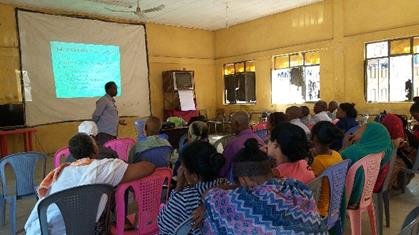
- Result 6.1: Organization oftraining and sensitization workshops. One training session has been organized on « effective communication and data recording » for selected 11 micro-credit members, 5 social workers, 6 project supportive committee members and 8 Community Based Organization (CBO) members for 2 consecutive days. One sensitization workshop to « raise awareness on the situation of OVC » has been organized for 5 targeted children, 6 project supportive committee members, 4 social workers, and 25 parents/guardians of children. One training on « Parenting, Disciplining and Communication skills » has been organized for 15 parents/caregivers, 6 project supportive committee members, 5 social workers, 2 Kebele 05 policemen, 3 teachers, and 4 members of Kebele 05 administration for 3 consecutive days.
- Result 6.2: Community based organization is trained to provide financial and material support to address the social and economic problems of OVC by the local resources mobilization and fundraising. One training on « Community Based Project Management, Local Fund raising and empowerment of the community » has been organized for 10 members of Kebele 05, 8 from CBO’s, 6 project supportive committee members, 3 from the school community, 9 members of the micro-credit cooperative, and 10 from parents/guardians of children. In total, 115 members of the community have been included in the different training sessions and workshops to acquire basic knowledge and experience for the upcoming management and implementation of the project.
The budget for this project for the year 2018 amounts to $93,163 and Secours Catholique-Caritas France is supporting it to the tune of $61,830.
![Sensitization workshop]()
Sensitization workshop
![Share on Twitter]()
![Share on Facebook]()