By Dr Mary Kelly | HANDS AROUND THE WORLD Volunteer
Ophthalmologist Dr Mary Kelly has just returned from her first visit to Benin, and wonders what the long term benefits over there will be. She is sure however that she will never be quite the same again… Here she writes about her 4-week HATW adventure:
I tried to do what I could for the eye problems of the lovely people who live in Affame. The main problems I found were cataracts, presbyopia, and pterigia. There was only one schoolchild that I saw with congenital cataracts, but there were 17 adults with senile cataracts, all of whom have been referred for surgery to Parakou.
Five people with pterigium (an overgrowth of conjunctiva which spreads across the cornea, in response to exposure to the sun’s ultraviolet rays, combined with exposure to wind and dust) have been referred locally to Adjhoun for surgery to remove the growth. Several people have also been sent there for treatment with eye drops, which will at least make the eyes less painful, for as long as they can be prescribed.
I saw one child with an active corneal ulcer, in whom immediate treatment with antibiotics was begun, and was successful. There were several other children and adults who had lost the sight of an eye due to corneal ulcers which had not been treated. In one village there were 3 such cases. I expected to see many cases of trachoma but only saw one definite case, and 4 cases of conjunctivitis which might have been early stages of the disease.
Many people complained of their eyes burning, and I’m sure that if I had had the use of a slit-lamp I would have found significant problems with the lubrication of the front surface of the eyes secondary to exposure to the elements. Anyone who could supply the widespread need for lubricant drops, and protective eye-wear, at affordable cost could relieve much discomfort, and prevent the development of serious eye problems.
I took with me some eye drops and ointments, antibiotics and lubricants, but soon ran out of supplies; then was unable to get hold of more from the local dispensary.

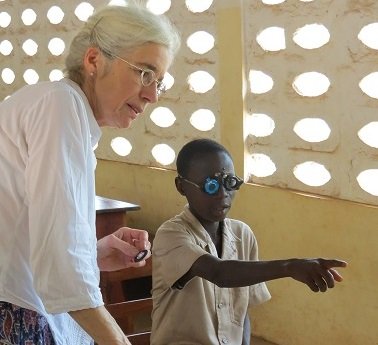
I carried out many sight tests. Nearly all the people who came said that they couldn’t see properly, including many of the schoolchildren. Only a small minority had a refractive error, which I did my best to correct with the glasses I had with me.
Amongst the adults, presbyopia was the main cause of difficulty, though few complained that they found close work difficult.The low literacy rate is the reason for this. However, anyone owning a mobile phone complained of not being able to see the numbers!
In all, about 120 pairs of glasses were given which were as near as possible to the required strength, and they were received with much delight. The Methodist minister who was able to read his bible once again on the Sunday we attended his service was one!
For the children, better lighting in the class rooms, (and smaller class rooms) would make reading off the blackboard less difficult.
It was for me both a great experience and a huge learning curve!
By David Steiner | HANDS AROUND THE WORLD Chief Exec
By Dr David Steiner | HANDS AROUND THE WORLD Chief Executive
Project reports on GlobalGiving are posted directly to globalgiving.org by Project Leaders as they are completed, generally every 3-4 months. To protect the integrity of these documents, GlobalGiving does not alter them; therefore you may find some language or formatting issues.
If you donate to this project or have donated to this project, you can receive an email when this project posts a report. You can also subscribe for reports without donating.