By Marie-Claude Pelchat | Project Leader
Helping burn rehabilitation specialists in India 2
In April 2013, Sunshine Foundation launched its newest capacity building cooperation project in India. Over a three-year period, Sunshine Foundation will provide technical support to International Foundation for Crime Prevention and Victim Care (PCVC), a Chennai-based NGO working in the field of victim care and prevention of gender violence, for the establishment of a Recovery and Healing Center for women burn survivors. Following a site visit carried out at the newly established Recovery and Healing Center in April 2013, the Sunshine team developed a specialized training program to help build the burn rehabilitation capacities of PCVC staff.
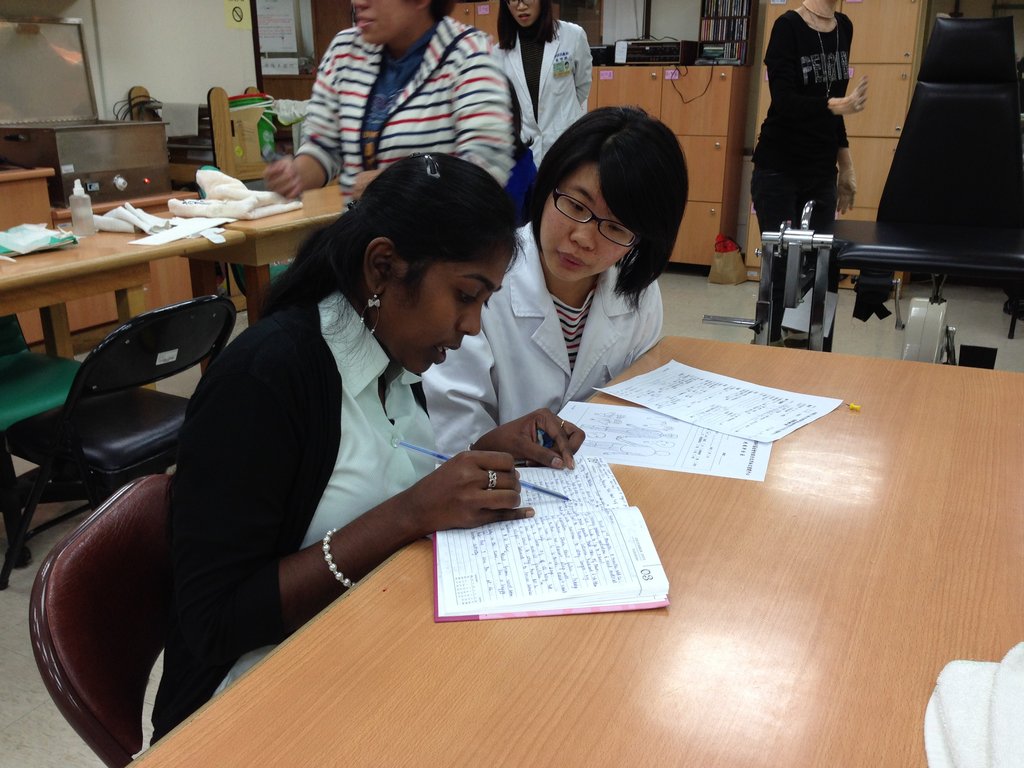
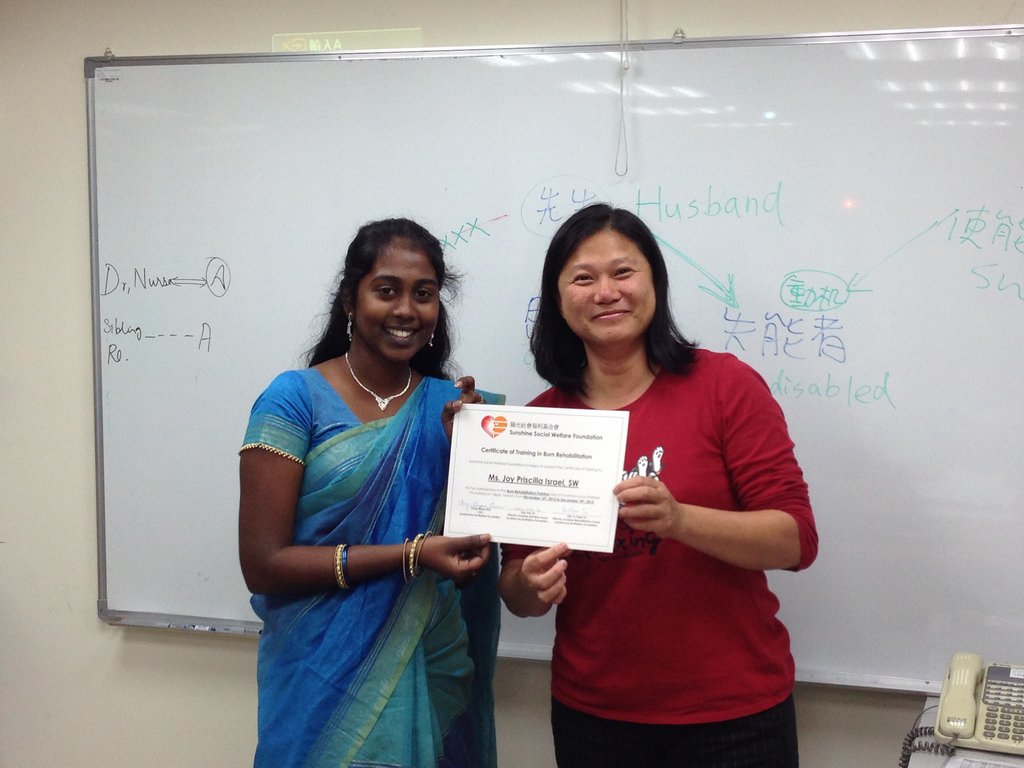
Sunshine had the immense pleasure of welcoming to Taiwan two PCVC staff for training from November 16 to December 14, 2013. The trainees were Buvi, a physical therapist and Joy, a social worker. For both of them, it was the first time to go abroad for professional training. For Sunshine staff, it was the first time to receive international trainees. The experience has been rewarding for everyone.
Joy – The social worker whose empathy bridges cultural and language barriers
It’s often difficult to describe what social workers working with burn survivors do exactly. Unlike therapists who rely on tangible equipment or exercises, social workers do not have any “visible” tools that will make their work obvious to the general observer. To understand the needs of clients and help build strategies to address these needs, social workers observe and talk to the client, to his family, to the other professionals working with him. By observing and talking, they gather information and eventually, they piece together a picture of the client’s story, his needs, expectations and desires for the future. From there, a service program to fulfill these needs is developed. In the process, social workers build a trusting relationship and provide emotional support. As a young social worker who has been working with Indian women burn survivors for over a year, Joy is familiar with this concept of planning and implementing a service program. However, there is a huge step from theory to practice when time comes to plan a truly “individualized” program.
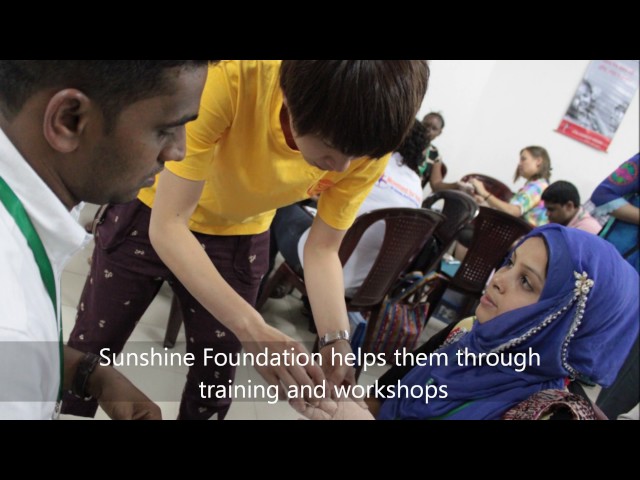
To help Joy bridge the gap between theory and practice, the Sunshine team arranged courses for Joy to explain our work process and methods, and she was also able to observe how our social workers and psychological counselors work with clients, what evaluation tools and techniques they use, etc. An individualized approach to service was particularly emphasized, where the different facets of a client’s needs are taken into consideration by the multi-disciplinary team when setting goals for services, including physical and psychological well-being, but also material well-being, learning, rights, relationships, etc. In order to put into practice the theory she learned, Joy was assigned two clients to follow and was given the challenge to develop a service program for them with specific short-term goals.
Apart from having to use new frameworks, Joy faced a huge challenge: how to communicate with clients who do not speak English (or can only manage a few sentences)? How to build a trusting relationship with them when they don’t understand each other? Of course, Sunshine staff was there to help with translation, but what made the biggest difference were Joy’s open and engaging attitude, as well as her sincere concern and the empathy she showed towards the clients. With these qualities, language could not be a barrier to building a trusting relationship with clients, and Joy engaged with them quite naturally, even without the help of a translator. In the end, Joy amazed everyone with her presentation of proposed service programs for clients, which showed sensitivity to clients’ needs.
Joy was mentored during her training by Hsiu-Hsiu TU, Director of Sunshine Half-Way House. Hsiu-Hsiu praised Joy’s keen sense of observation and her “active learning,” by which Joy constantly put her learning in context and related it with her work at PCVC. Hsiu-Hsiu was also very impressed with Joy’s eagerness to implement changes after going back to Chennai, such as building true multi-disciplinary team work and proposing more structured work processes. Sunshine will be able to see what Joy and her colleagues have been able to accomplish and provide support during another visit to Chennai by the Sunshine team scheduled for April 2014.
Project reports on GlobalGiving are posted directly to globalgiving.org by Project Leaders as they are completed, generally every 3-4 months. To protect the integrity of these documents, GlobalGiving does not alter them; therefore you may find some language or formatting issues.
If you donate to this project or have donated to this project, you can receive an email when this project posts a report. You can also subscribe for reports without donating.