By Communications Team | USA for UNFPA
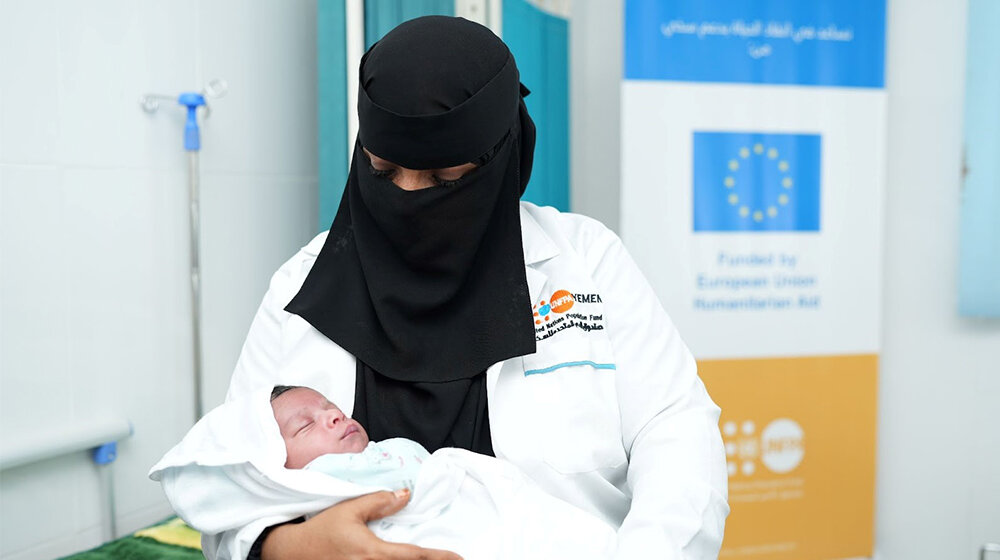
HADRAMOUT, Yemen – When Mona began working as a midwife in her local health center 30 years ago, she was the first in Yemen’s Hadramout Governorate.
“Back then, our area was a world away from health care,” she told UNFPA, the United Nations sexual and reproductive health agency. Now head of the midwifery department at the Shahir Health Center in Hadramout, she explained hers was an impoverished community that lacked schools, medical facilities and health workers.
“Women faced pregnancy without proper care or follow-up. The traditional midwife, with all her goodwill, was limited in resources,” added Mona. “Many births ended in complications, sometimes tragically. The city hospital was out of reach due to cost, transportation and sheer lack of awareness.”
For $400, you can help equip a midwife and maternity ward to help 50 women safely deliver healthy babies.
Fatima, a patient at Mona’s health center, confirmed this description of the past: “Survival hinged on pure luck, for both mother and child.”
Yemen has one of the highest maternal death rates in the world, and only one out of five functioning facilities currently offers maternal and newborn health services. Some 17.8 million people need healthcare assistance in 2024, among whom an estimated 5.5 million women need reproductive health services.
Mona was inspired to change the situation and enrolled in a midwifery training program in the nearby city of Mukalla after finishing school. When the Shahir health center opened in her village, she was quick to apply. “Despite limited funding and barely enough staff, we fought tirelessly for the well-being of our women.”
Your gift of $25 could provide 5 women with UNFPA Emergency Birth Kits and give them the items they need to prevent infection during childbirth.
As the backbone of community-based sexual and reproductive health services, midwives are a main gateway to health services in crisis settings, especially for the most marginalized.
The inequality of climate change
Mona recalled a harrowing day in 2015, when Cyclone Chapala hit Yemen just as war was erupting. Together with a team from her health center, she said, “we travelled treacherous terrain on foot to reach people in desperation.”
Despite howling winds and with barely any lights, “the thought of three lives hanging in the balance – a woman in labor with twins – fuelled our resolve and we reached them in time.”
When climate catastrophes strike or conflict breaks out, midwives are most often the first responders, representing the single-most effective way to avoid preventable maternal deaths. Research shows the climate crisis carries specific threats for women and girls, as disasters can lead to pregnancy complications and increase risks such as premature births and miscarriages.
UNFPA refurbished the Shahir health center in 2021 with medicine and supplies, and supported training sessions for health workers. Maternal mortality rates in the area have since dropped, as dozens of trained midwives now offer a comprehensive range of services – from maternal health to obstetric care, assisted by an ambulance, fully equipped operating room and medicine provided free of charge.
For $90, you could give two women everything they need to care for themselves and their babies after birth.
“After the devastation of conflict and climate disasters, it felt like a dream,” said Mona. “Families in the region, displaced people fleeing war and floods, were able to find solace here.”
Your Impact
Since the start of 2024, UNFPA has reached over 350,000 people in Yemen with lifesaving reproductive health care, protection and information, including support for over 100 health facilities.
Midwives are a critical part of this response, as providers of culturally sensitive care, as community leaders and as emergency responders. But the world is short of nearly one million midwives.
Like Mona, many midwives are forced to confront challenging work environments, low pay and a lack of career development – all factors driving the global shortage. Yet UNFPA research shows that increasing the coverage of midwives by 25 percent could save over 2 million lives annually by 2035.
Today, Mona is close to retiring, but she says she is relieved to be handing over the reins at her health center. “They are a team of highly trained, professional midwives, equipped to navigate the future of maternal health care.”
Project reports on GlobalGiving are posted directly to globalgiving.org by Project Leaders as they are completed, generally every 3-4 months. To protect the integrity of these documents, GlobalGiving does not alter them; therefore you may find some language or formatting issues.
If you donate to this project or have donated to this project, you can receive an email when this project posts a report. You can also subscribe for reports without donating.



Support this important cause by creating a personalized fundraising page.
Start a Fundraiser