By Communications Team | USA for UNFPA
KYIV, Ukraine—“We had already started surgery—a Cesarean section,” recalled Nataliia, a senior doctor at the Kyiv Regional Perinatal Center. “But at the beginning of the operation, the electricity went out.”
It was a freezing morning in January when the power was cut in Kyiv. Across Ukraine, targeted strikes over recent months have knocked out power, heating, and running water for millions of households, while temperatures have dropped to -4°F.
Inside the maternity hospital, health workers fought to keep women and newborns alive. Operating room lights, oxygen systems, incubators, and blood storage all depend on stable power—but the teams did not stop.
$150 can provide supplies, medications, and equipment to health clinics—helping ensure lifesaving care continues even during power outages.
“We have no right to panic,” Nataliia told UNFPA, the United Nations sexual and reproductive health agency. “We continue our work.”
She did not want the patient on her operating table to feel the fear of a healthcare system under attack. “She saw that the light disappeared, that’s all. She was focused on the birth of her child.”
Families at Home Face the Same Outages
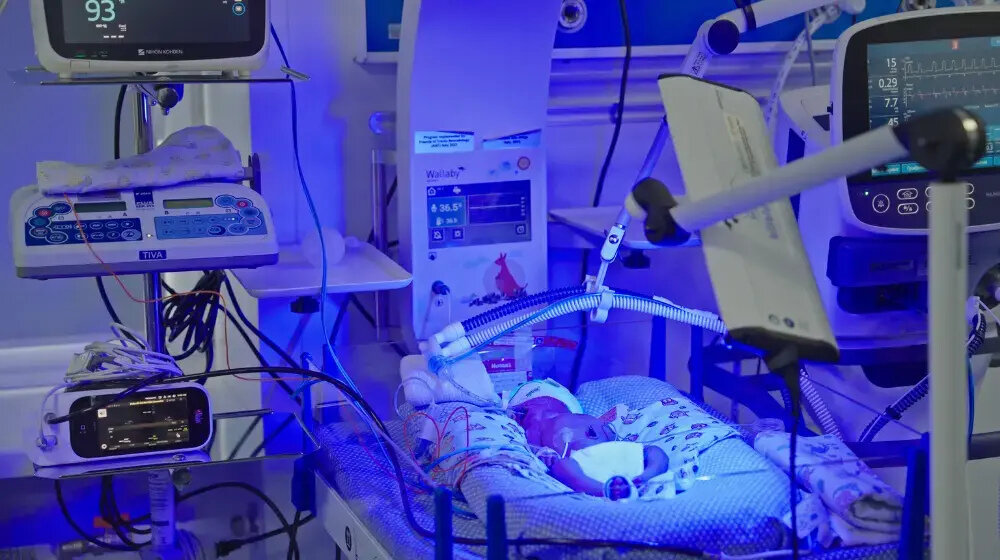
Electricity is critical for warmth—and for babies, warmth means survival. In the neonatal unit, doctors use transport incubators to move babies from delivery rooms to intensive care while protecting them from the cold.
Newborns are particularly vulnerable to hypothermia, as their body temperature can drop quickly in the first minutes after birth. Staff at the center described using a “thermal chain” of warming measures—from mobile and stationary incubators to heated rooms and extra blankets—to keep newborns stable, especially those born prematurely.
$50 can provide 10 emergency birth kits, including essential supplies to help keep mothers and newborns safe during delivery.
But power outages put this system at risk—and the danger does not end once mother and baby return home. Iryna, pregnant with her second child, explained: “Because of the outages, there’s no backup power, and the house doesn’t have time to warm up. Plus it cools down quickly.”
Her solution is familiar across Ukraine this winter: layers, improvisation, and endurance. “We bundle up. We try to keep warm.”
Stress Is Showing Up in Delivery Rooms
Health workers say the war is reshaping birth outcomes across Ukraine. From repeated displacement to disrupted healthcare services, doctors are seeing rising complications.
Premature birth rates have increased, with doctors linking this to prolonged and severe stress. In frontline areas, rates are reported to be roughly double the national average.
They are also seeing more potentially life-threatening complications, including hypertension and uterine rupture—clear signs of a maternal health system under strain.
In these conditions, reliable electricity becomes essential. It determines whether an already overstretched healthcare system can respond to emergencies when women and newborns are most vulnerable.
The Healthcare Workers Keeping It All Running
Ukraine’s healthcare system has been forced to adapt—through innovation, improvised safeguards, and the unwavering dedication of its workforce.
Nataliia described this as the most difficult period of the full-scale invasion so far—both emotionally and physically.
After long and exhausting shifts, health workers return home to apartments that may also lack electricity, heat, or running water.
“Despite bad weather, shelling, or air raid alerts, we still have to pull ourselves together and go to work, leaving our children or grandchildren at home,” Nataliia said.
“And when we arrive, our patients shouldn’t see our anxiety. Because we are responsible not only for ourselves, but for other people’s lives.”
The strain continues to build.
“We are also people. We have our own children and families,” she added. “We also get sick. We also feel afraid. We also suffer. But we have to keep going.”
Adapting to Prevent Collapse
With support from UNFPA, the perinatal center has installed layered backup power systems—including solar panels and emergency generators—to maintain electricity long enough to continue critical procedures when the grid fails.
For the most part, these systems work—but they are costly and not designed as permanent solutions. Even when functioning, they place constant strain on resources, requiring fuel, maintenance, and staff capacity.
Across Ukraine, hospitals are already stretched thin. While the government prioritizes healthcare facilities for fuel and equipment, financial constraints mean much of the country’s lifesaving energy support has come from international partners.
UNFPA is also supporting maternity hospitals across the country with backup energy systems and essential sexual and reproductive healthcare supplies.
Still, as winter continues and infrastructure remains under threat, experts warn that maternity hospitals can keep the lights on, incubators running, and oxygen flowing only with sustained international support.
$100 can help fund a midwife in a community for one month, ensuring women have access to skilled care—even in crisis settings.
Project reports on GlobalGiving are posted directly to globalgiving.org by Project Leaders as they are completed, generally every 3-4 months. To protect the integrity of these documents, GlobalGiving does not alter them; therefore you may find some language or formatting issues.
If you donate to this project or have donated to this project, you can receive an email when this project posts a report. You can also subscribe for reports without donating.



Support this important cause by creating a personalized fundraising page.
Start a Fundraiser