By barotte cindy | Project Leader
Since 2016, the association has been supervising and accompanying young civic service volunteers. Their presence within the association is precious. It allows them to accompany sick people and support their often exhausted caregivers. Each year, their mobilization allows us to accompany approximately 600 people. Their mobilization has greatly increased the capacity of the structure in a permanent way. It has enabled the association to extend its territory to the whole of the Ile-de-France region.
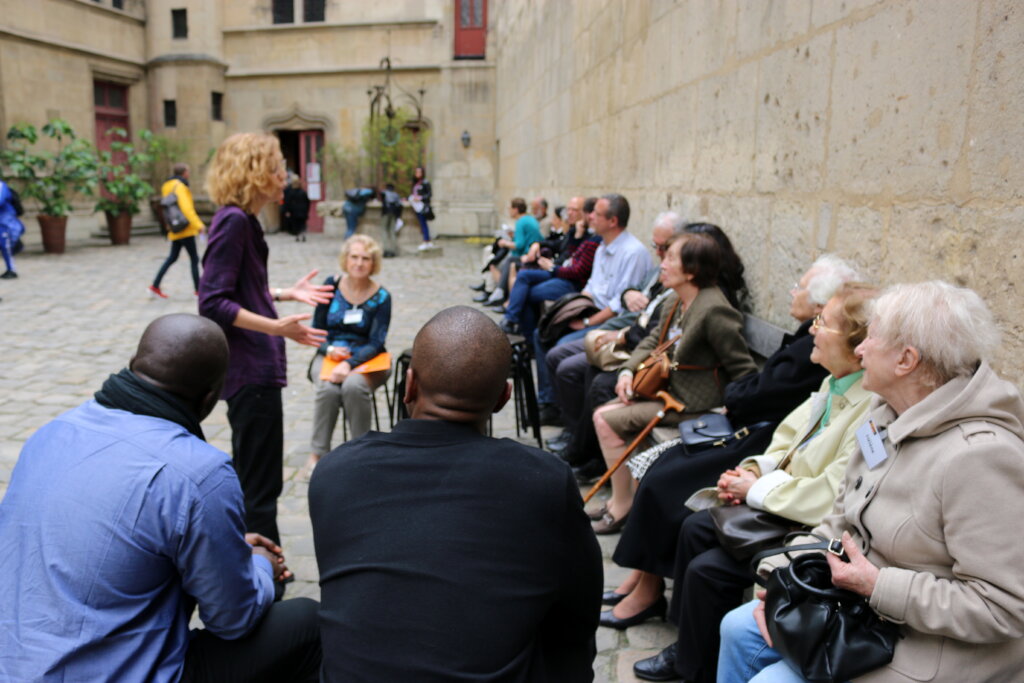
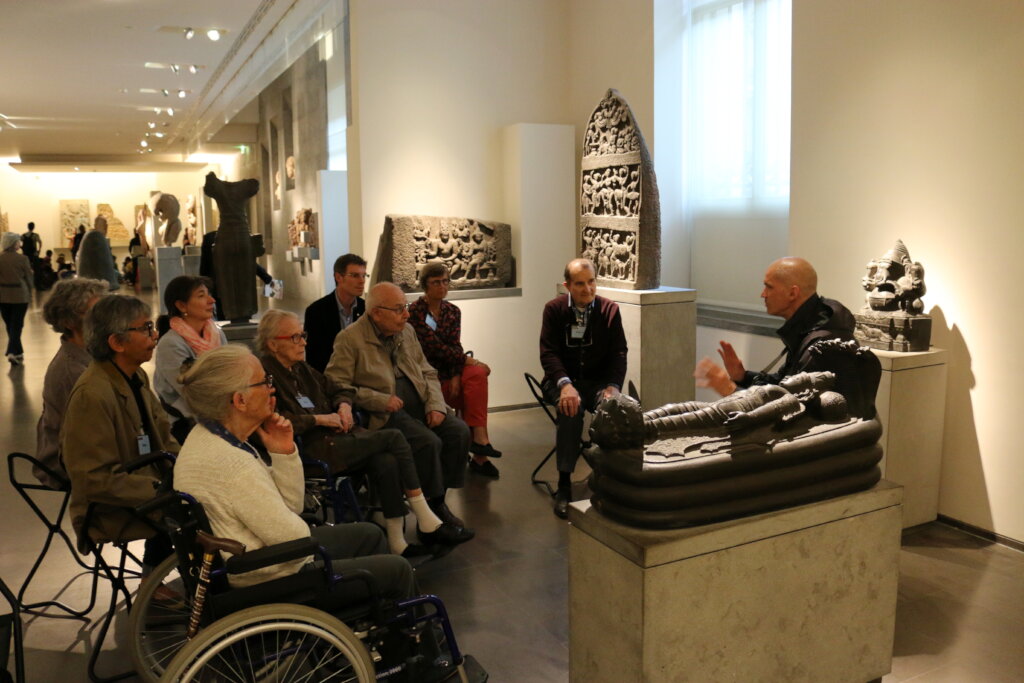
In 2022, 30 volunteers accompanied patients during the cultural activities offered by the association in museums and online. They offered free time to family caregivers but also involved them in the development of e-visits at home according to their needs and wishes. They support the access of the persons they accompany to the means of transport and to the computer tools, which enriches the meaning of their mission. They are also involved in the evaluation of the activities through semi-directive questionnaires. This involvement gives value to their mission within the association. Finally, they are trained to spot warning signs that they communicate to the psychologist of the structure. If necessary, these signs trigger an evaluation of the loss of autonomy and lead to referral to available aid. The volunteers are kept informed of the assistance provided and this contributes to their feeling of being useful.
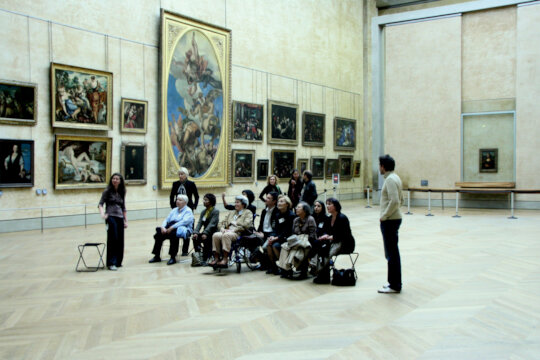
10 volunteers acted as co-facilitators and relays in relation to their skills and professional projects. They were trained to perform this function and were provided with the tools and the necessary supervision to carry out this function. Each relay volunteer accompanied a group for a period of three months. They provided logistical support during the activities, ensured the presence of all registered participants and ensured the comfort and atmosphere of the group during each session online, at the museum and in medical and social structures. To be a relay volunteer, interpersonal skills are required, particularly the ability to easily get in touch with others. A great adaptability towards the ever present hazards is necessary to carry out this mission as well as a positive mood and a certain dynamism. After additional training and in line with their wishes and skills, these volunteers have been co-leading museum outings and online tours. This training covers both the methodology of conducting activities developed by the association and a corpus in art history. It should be noted that most of the candidates for this mission have studied art history and are destined for a career in culture. This experience contributes to their professionalization in this field. During the different activities, the relay volunteers take pictures and collect verbatims that feed the social networks.
In order to support them significantly in their future project and to provide them with skills that will be of full use to them in their mission but also in their professional project, the association has designed training modules on neuro-evolutionary disease, cognitive stimulation through art, the experience of the caregiver, the care pathway, art history, communication, know-how in a professional environment, Microsoft tools, and Zoom made available, telephone calls, public speaking, e-reputation and information necessary for the proper use of social networks. Since the health crisis, the training of volunteers includes the detection of warning signs corresponding to a loss of autonomy and a preparation for the individual animation of an e-visit in order to be able to propose to a person who presents difficulties to continue the activity according to more adapted modalities. Finally, the training includes a semi-directive questionnaire to evaluate the level of satisfaction of the families with the system. The involvement of the volunteers in the evaluation brings meaning to their mission.
In addition to this training and to support the volunteers in the realization of their mission and in the elaboration of their future project, the association has set up weekly follow-up and experience sharing meetings as well as regular individualized assessments in relation to their future projects. The association also organizes informal and convivial times that encourage and support team spirit. The weekly meetings are now often organized remotely, in an efficient and less restrictive way for the volunteers, the tutor and the employees involved. This evolution is an acquisition linked to the health crisis.
The civic service volunteers received have benefited from the supervision of a tutor. In 2021, once again, a very significant part of the salaried time of two members of the association was devoted to supporting the volunteers in carrying out their missions. The association's role with the volunteers consisted in ensuring their training, their preparation and the organization of the missions entrusted to them, in following them and accompanying them in the realization of their missions, in supporting their motivation and in bringing them together within a dynamic and united team.
From a pedagogical point of view, they were supervised by a training provider who enabled them to acquire and develop a set of skills that they gradually acquired and that will serve them in their professional future: ability to work in a team, to speak in public, to adapt to different situations, to adopt the codes of professional life, to listen and to show initiative. Through the mobilization of a tutor with a master's degree in education and work sciences, each of them was individually accompanied in their professional project and was able to prepare for their future job interviews. The tutor contributed to the integration of their experience within the association in the framework of their professional project.
Generally speaking, the benefits for the volunteers and accompanying volunteers correspond to the pleasure of giving pleasure and feeling useful, to a personal enrichment linked to relational capacities, to listening and to the development of empathy, to a better understanding and a different perception of Alzheimer's disease, to a relationship experienced as rich and moving and finally to the discovery of another way of discovering works of art based on feelings and relationships.
Here are some examples of testimonials:
« Ce qui m'intéresse,dans la manière dont les visites sont conduites par l’association ARTZ,c’est l’approche descriptive et la progression pas à pas dans la découverte de chaque œuvre.C’est également le fait que chaque participant est acteur de la visite et que la découverte se fait tous ensemble. Les visites sont ludiques et stimulantes pour la mémoire. Elles comportent uniquement la découverte de 4 à 5 œuvres pour une meilleure exploration en profondeur ».
« L’approche, par touche et par étape apprend à prendre son temps pour observer une œuvre, pour éviter de restersurunepremièreimpressionetpourécouterlepointdevuedesautresparticipants.Lefaitdecommenter uniquement 4 œuvres par visite permet de mieux s’en imprégner et de mieux se les remémorer. »
« Les visites sont à la fois ludiques et culturelles.J’aime beaucoup cette approche qui est plus chaleureuse qu’une conférence classique.Je trouve cette activité stimulante.Cela m’oblige à travailler ma mémoire le fait de regarder un tableau longuement et de réfléchir devant. »
« Pour moi,cette approche est nouvelle.J’ai vu avec plaisir des œuvres que je n’aurais pas eues l’idée devoir.
L’observation attentive menée permet de voir des éléments qui passeraient inaperçus et de mémoriser les œuvres. Ces visites me plaisent, car il est plus stimulant de participer et de donner son avis ».
«Ces visites sont très agréables et permettent de nombreux échanges. L’approche est ludique et il est très agréable de découvrir une œuvre ensemble.Tous les participants sont invités à s’exprimer. Chacun est invité à être attentif et à observer ».
«C’est mieux qu’une visite classique,car on passe du temps devant chaque œuvre et on les voit avec un autre regard. Nos neurones sont stimulés et la découverte est superbe. Echange, partage, discussion, convivialité contribuent à la dynamique de groupe qu’anime notre guide ARTZ »
Links:
Project reports on GlobalGiving are posted directly to globalgiving.org by Project Leaders as they are completed, generally every 3-4 months. To protect the integrity of these documents, GlobalGiving does not alter them; therefore you may find some language or formatting issues.
If you donate to this project or have donated to this project, you can receive an email when this project posts a report. You can also subscribe for reports without donating.