By Chris Hufstader | Oxfam
In a dry land, health workers help malnourished neighbors survive Using simple tools for screening basic nutritional status of their neighbors, trained health workers in Ethiopia ensure food aid goes to the families needing it most.
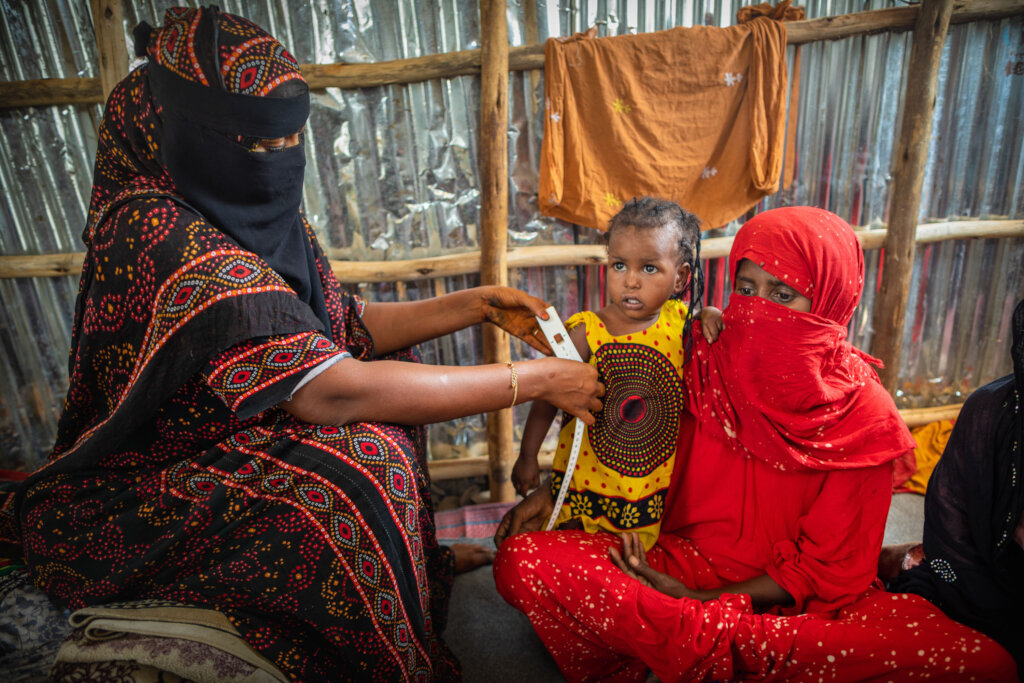
Fatuma pulls out her measuring tape and wraps it around the upper arm of a 2- year-old girl, mid-way between her shoulder and elbow. She’s looking at the girl’s mid-upper arm circumference, an indicator of nutritional status. Fatuma is pleased with the result: Until recent weeks, this young girl’s measurements indicated she was suffering from malnutrition.
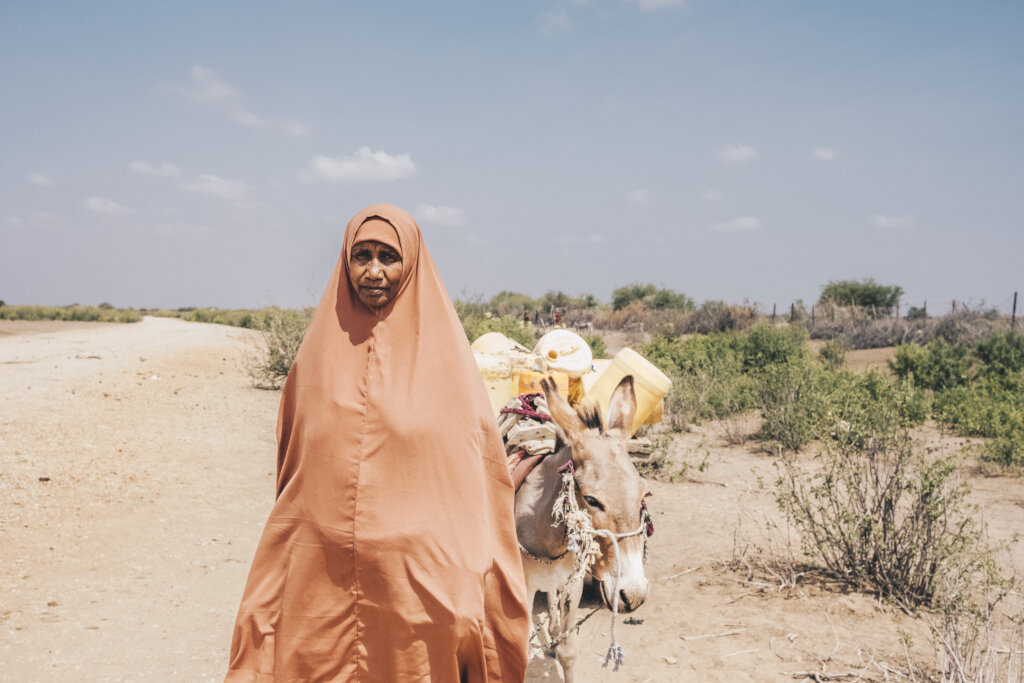
Although she is glad to see improvement, Fatuma still has concerns for the people in her village, a remote, windswept and tree-less rocky hilltop village called Guhom in Ethiopia’s arid northeast Afar Region. This part of Afar is suffering through an extended drought, diminishing the herds of camels and goats on which this town of roughly 5,000 people rely for their survival.
Lack of water and poverty are proving a dangerous mix in Guhom. “Infants and other children really need help,” to avoid severe malnutrition, Humad says.
Neighbors helping neighbors
Fatuma is one of eight health extension workers trained by the Afar Pastoralist Development Association (APDA) in Guhom, working with support from Oxfam. These volunteers, all women, learned how to help people suffering from acute malnutrition, particularly children and young mothers struggling to breastfeed newborn babies. They are among 40 health workers trained by APDA across Afar.
APDA, in collaboration with Oxfam, also provided three months of food to about 2,000 families in and around Guhom that included wheat flour, cooking oil, maize flour, chickpeas, and lentils. The families were selected based on data collected by the health workers, who go from home to home to monitor the mid upper-arm circumference (MUAC) and weight of children, pregnant women, and breastfeeding mothers.
The project also supplied special high-calorie and nutrient-rich ready-to-eat therapeutic foods for the most severely malnourished people. Fatuma and the seven other health workers in Guhom had recently screened 560 children, 17 of whom needed urgent treatment for malnutrition. Of the 700 women screened, 238 needed treatment. “We check their weight, and we give them food until they get better,” Fatuma explains. “We can only give the supplementary food to people who are really in need. We monitor their weight every day and check the MUAC.”
Crisis in Afar
In the middle of 2024, parts of the Afar Region were facing a crisis due to multiple factors, including ongoing drought due to climate change, and fighting between Afar clans and those of the nearby Somali Region. This was leading to a severe outbreak of cholera as people displaced by conflict and suffering from drought turn to unsafe sources of water.
Nearly half the 2.2 million people in this overlooked northeast corner of Ethiopia live in poverty, according to Mohamed Ahmed, deputy director of APDA. Providing them with crucial humanitarian assistance is a major challenge for the government and groups like APDA. “People have a right to basic nutrition,” Ahmed says. “We know Afar is the most malnourished region in Ethiopia. For many years we have been distributing food aid, but it has been reduced due to inflation.”
Food aid delivers better nutrition
One of the families receiving food aid and supplemental food in Guhom is that of Zahara. Zahara says that recently her daughter was very malnourished. “She was really bad,” Zahara says, as Fatuma checks the child’s MUAC measurement in their home. “I was also suffering.” Fatuma acknowledged how difficult it was for both mother and daughter. “I could see Zahara was also suffering, both were in a lot of pain,” she says.
Fatuma helped Zahara and her daughter find the supplementary food they needed, and watched their health improve. She credits the food aid delivered by APDA. “The food helped people, we saw significant improvements for the mothers,” Humad says. “And after I saw the child’s improvement, I was happy.” “When I see improvements, I feel happy – especially in the children.” Oxfam’s work in Afar is funded partly by the Australian Humanitarian Partnership.
What is MUAC?
MUAC stands for Mid-Upper Arm Circumference. It is a measurement of the mid-point between the shoulder and elbow, using a measuring tape that is checked against optimal MUAC ranges by age to determine whether someone is malnourished. For example, a 2- year-old’s MUAC measurement should be more than 11 centimeters. For older children, less than roughly 13.5cm indicates poor nutritional status. A well-nourished pregnant woman should be above 23cm.
Links:
Project reports on GlobalGiving are posted directly to globalgiving.org by Project Leaders as they are completed, generally every 3-4 months. To protect the integrity of these documents, GlobalGiving does not alter them; therefore you may find some language or formatting issues.
If you donate to this project or have donated to this project, you can receive an email when this project posts a report. You can also subscribe for reports without donating.



Support this important cause by creating a personalized fundraising page.
Start a Fundraiser