By Communications Team | USA for UNFPA
“I want to use what I’ve learned here to help others. I don’t want to waste my time—I want to lead sessions and tell girls they have a choice.” — Sarifa, 12, Rohingya refugee and youth champion
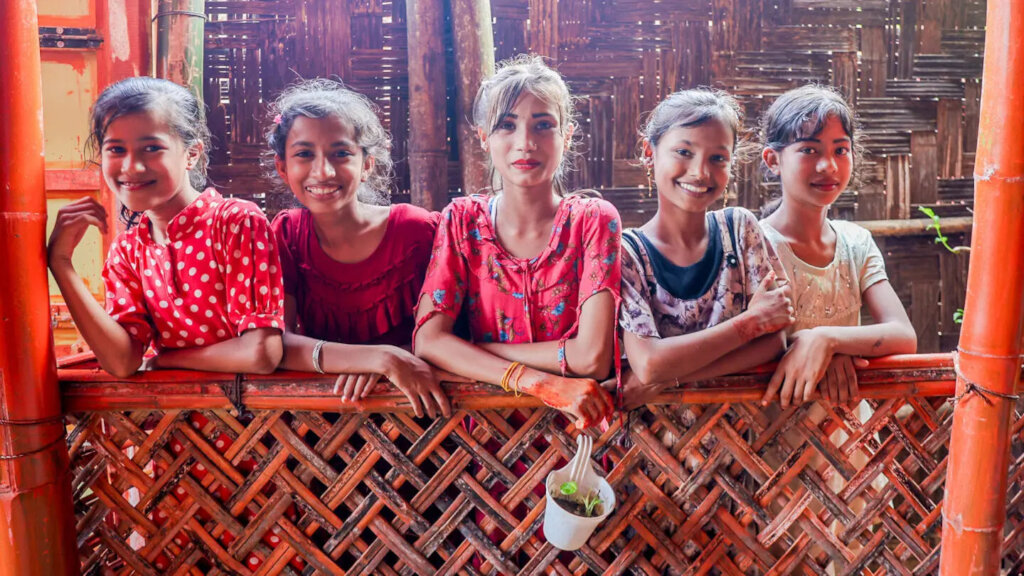
Cox’s Bazar, Bangladesh – In the heart of the world’s largest refugee settlement, young Rohingya girls and boys are becoming powerful voices for change, challenging harmful practices like child marriage and shaping a future they dream of.
Teenagers and youth make up over one-third of the Rohingya refugee population in Cox’s Bazar and Bhasan Char. Displacement, poverty, and limited access to education or livelihood opportunities expose them—especially girls—to increased protection risks, including early marriage. With nearly 90% of youth out of school or training, and more than 80% lacking access to life skills, their aspirations often remain out of reach.
Through UNFPA programs like Girls Shine and Champions of Change, implemented by partners Plan International, Mukti, and Prottyashi, young people are designing their own futures. UNFPA currently supports eight youth centers across the refugee camps, providing safe spaces where young people can access learning sessions, psychosocial support, and life skills.
For $360, you can fund a safe space for women and girls who have survived violence for one day.
At a Youth Center buzzing with energy, 12-year-old Sarifa confidently explains the risks of child marriage. “When young girls are married, they lose their health, their education—everything. I want to stop that. I want to help my peers do the same,” she says.
Usmaida, 11, dreams of becoming a doctor. “I tell my mother and friends what I learn here. When I feel sad, I come to the center, look in the mirror, and tell myself: I am strong. I am resilient.”
Yasmin, 19, a young mother of a 15-month-old daughter, attends sessions on menstrual hygiene and well-being. “It was taboo to talk about menstruation before. But here, we learn, we ask, we share. When I’m stressed, I call the helpline or speak to a counselor. I feel heard.”
A gift of $25 can provide a woman with hygiene essentials for six months, enabling her to maintain her dignity no matter what.
With accessible visuals and interactive tools, these centers are also closing the gap in basic education and health literacy for youth who have missed years of learning. Sessions are held three times a week, building skills in communication, problem-solving, and emotional resilience.
Alkama, 12, who recently joined Girls Shine, learned about child marriage and violence against women through a role-play exercise. She can now distinguish between good and bad touch thanks to her participation in the community session.
“Now we know that girls shouldn’t marry before 18, and boys before 21. It’s harmful for the girl—and for the baby if she gives birth too early.”
The ripple effects reach families and communities. Caregivers attend parallel sessions that address social norms, health, safety, and parenting. Boys and young men, often excluded from such dialogues, now join Champions of Change to explore power, anger, empathy, and nonviolence.
Mobbasara, 11, sends a message to the world: “Stop violence against us. Girls deserve safety, education, and respect.”
The sessions are facilitated by dedicated staff like Mukta Rani Debi, Community Mobilization Officer, who works daily with youth champions to build their leadership skills and confidence.
“Many girls in the camp still face deep-rooted restrictions and are not allowed to move freely, speak up, or even attend our sessions,” says Mukta. “That’s why we organize regular outreach visits and mothers’ meetings—to bring information directly to their homes. With the help of young peer leaders, we talk about early marriage, health, and the right to education. My dream is that these girls grow up confident, educated, and able to decide their own futures.”
The impact is tangible. In the second quarter of 2025 alone, over 111,000 visits were recorded at UNFPA adolescent- and youth-responsive spaces, where young people and their caregivers accessed information, psychosocial support, and life skills.
Suma Barua, Child Marriage Technical Officer—who represented Bangladeshi youth at the ICPD anniversary last year—explained:
“This center has been operating since 2018. We’re not just telling youth what not to do—we’re showing them what’s possible. They’re building a library, starting gardens, designing their own solutions. This is their space.”
Instead of warning about the dangers of child marriage, facilitators focus on the benefits of delaying it: more time to learn, earn, and grow into empowered adults who can care for their families and communities.
In these safe spaces, girls are learning to stitch, sew, and speak up. Boys are learning to listen. Together, they are shifting the narrative from helplessness to empowerment and hope.
UNFPA celebrates the determination of Rohingya adolescents who are standing tall, refusing to be defined by crisis, and building a future where every girl can shine and every boy can be a champion.
Thank you for your ongoing support of this vital work. A donation of $600 prevents one girl from becoming a child bride, so she can enjoy her childhood.
Project reports on GlobalGiving are posted directly to globalgiving.org by Project Leaders as they are completed, generally every 3-4 months. To protect the integrity of these documents, GlobalGiving does not alter them; therefore you may find some language or formatting issues.
If you donate to this project or have donated to this project, you can receive an email when this project posts a report. You can also subscribe for reports without donating.



Support this important cause by creating a personalized fundraising page.
Start a Fundraiser