By Konrad Suder Chatterjee | Communications Manager and Resource Developer
Dear Friends,
Since our last update in March, one thing has changed that we have been waiting a long time to be able to write to you about.
Three members of the Gaza Monologues group are making it to France.
We want to be precise about what this is, because precision matters here. This did indeed happen through the Pause programme. You may remember that in April 2025 we submitted files for ten families of our Gaza writers, with the backing of National Theatres in France who were ready to host the group for two years. The French government then stopped the programme. The plan we had built, for ten families, collapsed. Now it is reopened, with a very limited scope.
What happened instead is that three people got out as individuals. Three, not ten families. It took months of paperwork, follow-up, and the kind of persistence that is only possible when you are in direct and continuous contact with the people involved. It is a real thing and we are glad of it. It is also very far from what we were trying to do.
The others are still in Gaza, some of them in Egypt, some of them in other parts of the world. Their families are still in Gaza, including the families of the three who left, in several cases. Leaving does not mean arriving somewhere safe and complete. It means being somewhere else while the people you love remain where you were.
So this update is not a success story with a clean shape. It is a report about a door that opened slightly, for a small number of people, after a much larger door was closed by a government decision that none of us could influence.
Your support is what has allowed us to keep working on this at all. Being able to respond to individual situations as they arise, to cover the costs that come with them, and to stay reachable through months in which almost nothing about the situation was stable, is what made three individual exits possible rather than none. The same fund continues to go where the writers tell us it needs to go: food, water, medicine, rent, transport, the cost of staying connected, care for children and elderly relatives. These are not categories we invented. They are what people ask us for.
Alongside this, and separately funded, the writers have continued to work.
We want to be clear about the funding, because we think you should always know which of our activities your donations carry and which they do not. Our psycho-social drama programme in Gaza this summer was implemented with the Palestinian Performing Arts Network and supported by Drosos. It is not paid for from this fund. We are telling you about it anyway, because it is the clearest picture we can give you of who these writers are right now.
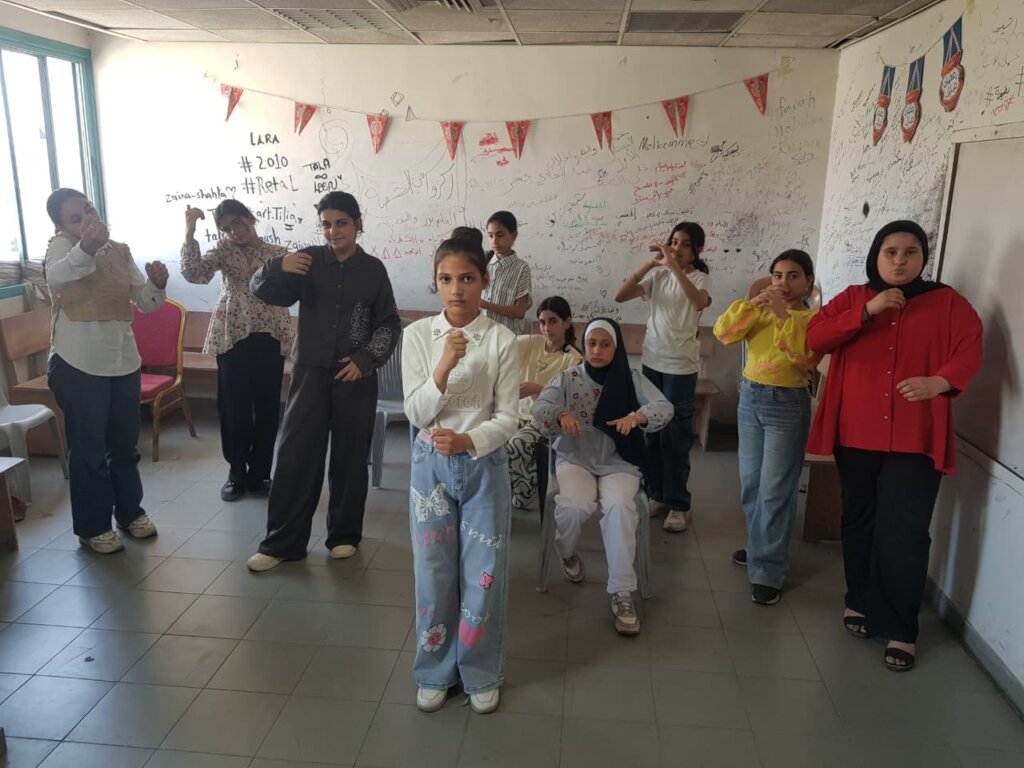
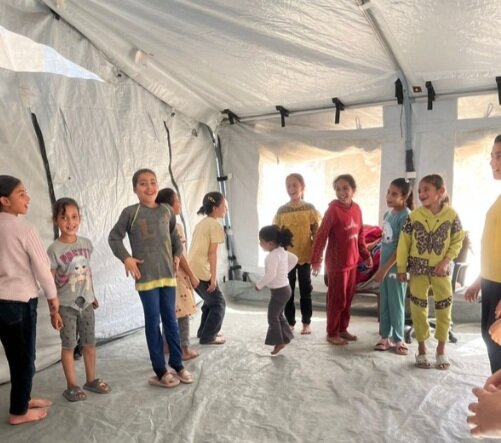
Over June, ASHTAR trainers worked with a hundred children between the ages of twelve and fifteen, in ten groups, across ten sessions of two hours each, at the Go On centre. Several of the trainers running those sessions are original Gaza Monologues writers.
Their own written evaluations of the work are in front of me as I write this. One of the exercises they use asks each child what their name means, who chose it, and why. It sounds like a warm-up. What the trainers describe is that it opened into something else: children remembering out loud, together, the people and the places that belong to the time before the war. Another exercise asks the children to sit still and count the sounds coming from outside the room. The trainers found that the children loved it, because it gave them back a few minutes of quiet and let them discover something they could do.
One trainer wrote that the hardest part of the work was not the exercises at all. During the war the children lost their confidence in themselves and in the people around them, so the real task was rebuilding trust, first in themselves and then in him. Another wrote about a girl who refused to speak at the beginning and was talking by the sixth session, and a boy who was too shy to read his own writing until the ninth day, when he stood up and read it out loud to everyone.
The trainers also told us what they need, which is unglamorous and specific: safe flooring so children can move without hurting themselves, simple equipment, balls and ropes, rooms that are not too small. Almost all of them noted that the space they had was cramped, and almost all of them added that under current conditions it was still better than most of what is available.
The thing they mention most often, though, is that the children took the games home. Parents, siblings, and neighbours ended up playing them. Whatever happened in those rooms did not stay in those rooms.
Outside Gaza, the monologues have kept travelling. In Seoul, fifteen performers read the full Korean text of the New Gaza Monologues at the Seoul Theater Center, and a smaller group of theatre workers held their own reading in a private space. In Berlin, an audio walk took the writers' testimonies through the streets of Neukölln along a route of Stolpersteine, so that two histories were held in the same hour of walking. In Highland, New York, four young actors performed eight of the 2024 monologues with live music, and the audience was invited to respond afterwards in improvisation. Every one of these events raised money. All of them did something else as well, which is to keep the writers present, named, and heard in places they cannot currently travel to.
The needs have not decreased. Three people leaving does not reduce them; if anything it clarifies how many people remain, and how narrow the routes out actually are.
We are still in contact with almost all of them. They are still writing. They are still working with children. They are still asking us for things we can sometimes provide and sometimes cannot.
Thank you for making it possible for us to stay in this relationship, and to keep saying yes when we can.
With gratitude and solidarity,
Konrad with the entire team at ASHTAR Theatre
Konrad Suder Chatterjee Communications Manager and Resource Developer ASHTAR Theatre, Palestine
Links:
By Konrad Suder Chatterjee | Communications Manager and Resource Developer
By Konrad Suder Chatterjee | Communications Manager and Resource Developer
Project reports on GlobalGiving are posted directly to globalgiving.org by Project Leaders as they are completed, generally every 3-4 months. To protect the integrity of these documents, GlobalGiving does not alter them; therefore you may find some language or formatting issues.
If you donate to this project or have donated to this project, you can receive an email when this project posts a report. You can also subscribe for reports without donating.



Support this important cause by creating a personalized fundraising page.
Start a Fundraiser