By Anna Shepherd | Partnerships Manager
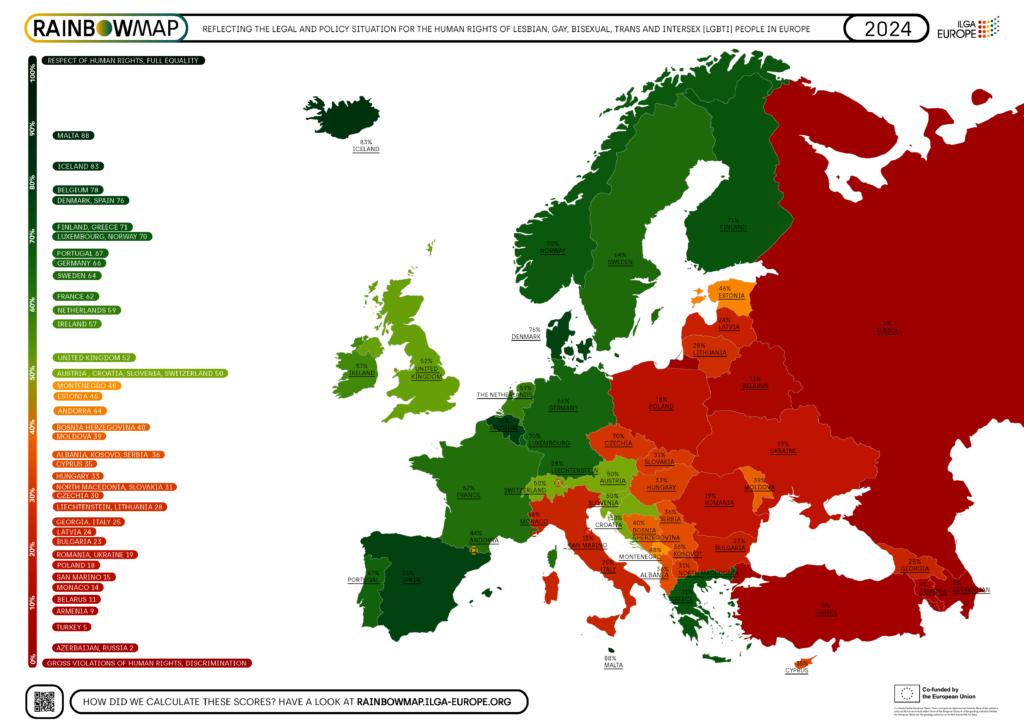
Published on May 15, ILGA-Europe's 16th annual Rainbow Map, which ranks 49 European countries on LGBTI human rights, shows that while authoritarian leaders across Europe continue to use the scapegoating of LGBTI people to divide and mobilise their electorates, others are conversly showing robust political will to honour commitments to advancing and protecting the human rights of LGBTI people.
At a time when some Italian regions are withdrawing parenthood rights from same-sex couples, when efforts are being made to rewrite guidelines to limit access to trans-specific healthcare in Slovakia, Croatia, France and the UK, and when we are witnessing Russia’s unprecedented move of criminalising the ‘international LGBTI movement’ as an ‘extremist organisation’, the findings of this year’s Rainbow Map make it more clear than ever that only legal protections can ensure that fundamental rights are guaranteed.
Dig into a wealth of data on the interactive Rainbow Map website, or take a look at the key developments in the summary below.
RAINBOW MAP EXECUTIVE SUMMARY 2024
For the ninth year in a row, Malta continues to occupy the number one spot on the Rainbow Map, with a score of 88%.
With 83 points, Iceland jumped to second place with a rise of three places as a result of the new legislation banning conversion practices and ensuring the trans-specific healthcare is based on depathologisation.
Belgium also banned conversion practices and now comes third place on the ranking with a score of 78.
The three countries at the other end of the Rainbow Map scale are Russia (2%), Azerbaijan (2%), and Turkey (5%). Russia lost 7 points and dropped 3 places because of the federal legislation banning legal gender recognition and trans-specific healthcare.
Poland still sits at the end of the EU ranking with 18% points, followed by Romania (19%) and Bulgaria (23%).
Germany, Iceland, Estonia, Liechtenstein, and Greece are the countries with the biggest jumps in scores. Germany prohibited hate crimes based on sexual orientation, gender identity, and sex characteristics. While both Estonia and Greece amended their laws to allow same-sex couples to marry and adopt children, Greece also filled the gaps in their anti-discrimination legislation to fully protect LGBTI people. Liechtenstein extended adoption rights to same-sex couples.
Montenegro lost the most points (-13%), dropping 9 places because it failed to adopt a new equality action plan or introduce updated policies on asylum and hate crime.
Alongside Montenegro, governments in Spain, Slovenia, Finland, Sweden, and many other countries failed to renew their action plans. France, Malta, Scotland and Wales adopted effective and comprehensive equality action plans.
In many countries, legislative proposals that have been on the table for years are not moving forward. This includes the hate crime legislation and proposal for recognition of same-sex partnership in Ukraine, which despite endorsement by several ministries and support throughout society is still being stalled. It also includes a draft law on legal gender recognition in Czechia that would finally get rid of the sterilisation requirement. After five years of delay, the UK government still hasn’t followed its promises on banning conversion practices. And despite many court cases and recommendations from international institutions, Lithuania didn’t progress on recognition of same-sex couples.
Belarus began categorising LGBTI content as “pornography”, restricting freedom of expression of LGBTI people. Bulgaria and Greece failed to protect LGBTI public events, thus lost points in relation to civil society space.
Both in Denmark and Poland, administrative procedures were improved for minors’ access to legal gender recognition (LGR). Although Germany and Sweden adopted new regulations for LGR, the laws have not come into effect yet, so they are not reflected on the map.
In many countries, legislative processes for new LGR procedures have been stalled this year. Similarly, no country prohibited unnecessary medical interventions on intersex children.
Most European countries still don’t include sexual orientation, gender identity or sex characteristics as qualification criteria for asylum. In an overall climate of governments increasingly undermining the international right to asylum, this ongoing omission is very worrying. This year’s only progress in this area was Czechia adding SOGI in their asylum law and Ireland providing a consistent training framework for their asylum caseworkers.
Links:
Project reports on GlobalGiving are posted directly to globalgiving.org by Project Leaders as they are completed, generally every 3-4 months. To protect the integrity of these documents, GlobalGiving does not alter them; therefore you may find some language or formatting issues.
If you donate to this project or have donated to this project, you can receive an email when this project posts a report. You can also subscribe for reports without donating.



Support this important cause by creating a personalized fundraising page.
Start a Fundraiser