By Zoe Broisson | HR & Finance Officer
At a time when LGBTI rights are under coordinated attack globally, ILGA-Europe continues to secure crucial victories through strategic litigation, international advocacy, and support for activists on the ground. From landmark court rulings to defending fundamental freedoms, our recent work demonstrates that progress is possible even in the most challenging contexts.
Securing justice for trans rights in Europe
After more than a decade of advocacy, a landmark victory has been secured for trans and non-binary people in the Czech Republic. The European Court of Human Rights has ruled that forcing trans people to undergo sterilisation to gain legal recognition violates their fundamental human rights.
"This is a great day for non-binary and trans people, one of the most marginalised groups," says T. H., the non-binary individual at the heart of the case. Since 2012, T.H. has repeatedly petitioned Czech authorities for legal gender recognition without being forced to undergo surgery—and was repeatedly denied.
The European Court's judgment is unequivocal: requiring sterilisation breaches the right to private life under the European Convention on Human Rights. This builds on earlier rulings by the European Social Charter Committee in 2018 and the Czech Constitutional Court in 2024.
Despite these victories, the Czech government has failed to establish a clear legal framework. According to research by the National Institute of Mental Health, 90% of trans people in the Czech Republic are dissatisfied with the current system. From July 2025, sterilisation is no longer legally required—but without proper legislation, the process will rely solely on ministerial guidelines that can easily be changed.
ILGA-Europe, alongside TGEU and Czech organisation Trans*Parent, filed a crucial third-party intervention in T.H.'s case. "This judgment yet again reminds the Czech Government of its obligation to put an end to this ongoing human rights violation," says Marie-Hélène Ludwig, ILGA-Europe's Senior Strategic Litigation Officer.
Additionally, a long-awaited opinion of the Advocate General of the Court of Justice of the European Union stated that under EU law provisions on freedom of movement and fundamental right to private and family life, member states have an obligation to legally recognise the lived gender of their nationals. While Advocate General’s opinions are not binding, their conclusions are taken into consideration by the CJEU judges and are often indicative of their ruling. A positive judgment from the CJEU would be of the utmost importance for the protection of trans people still deprived of any possibility of having their gender identity recognised in some EU member states.
Protecting our fundamental freedoms
Just in the last weeks, Slovakia rewrote its Constitution. They’ve enshrined harmful provisions targeting trans people and families created by same-sex couples. But, hidden amongst the changes, is an amendment that states that Slovak law outrights EU law on issues like family and gender – using language so vague, that Slovakia could block almost any EU initiative, regardless if it concerns LGBTI people or not. If Brussels doesn’t push back, other populist leaders will be lining up to follow suit. Once again, our communities are used as a pretext. These provisions pave the way to broader bans: on Pride, on functioning of organisations, on the freedom of media, or on sharing any information related to LGBTI issues. Like in Kazkhstan, where just last month authorities have announced further steps toward drafting and adopting legislation to ban the dissemination of LGBTI-related content. We’re working with other organisations to raise awareness and mobilize opposition, and prevent the authorities from installing further limitations to the rights of LGBTI people.
Not long before that, Enes Hocaogullar, 23, a youth delegate to the Council of Europe, was arrested at Ankara airport upon returning to his country. Turkish authorities say he “spread misleading information” and “incited public hatred” after he spoke in Strasbourg about police violence and the arrest of elected mayors back home. His comments quickly became the target of a coordinated smear campaign, painting him and his organisation as agents of “moral corruption” and “foreign influence”. We mobilized responses from institutions and supported local organisations in the country. Enes is now released pending trial, but the oppression of activists in the country continues.
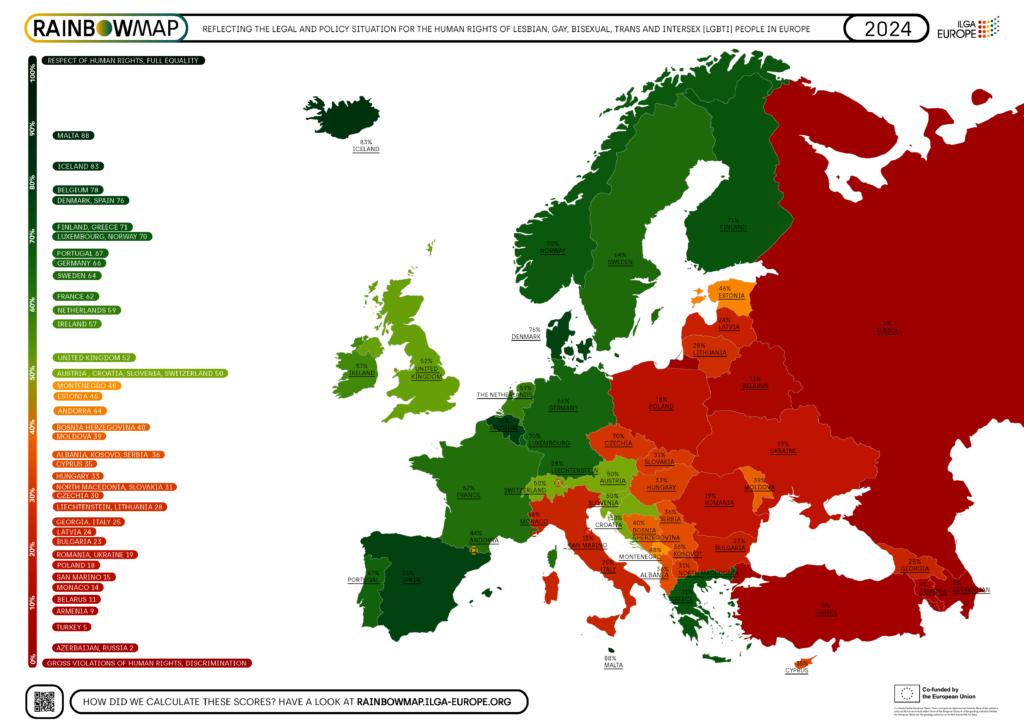
Developments like these make it even more important that regional institutions, including the European Union, use all tools at their disposal when states violate the fundamental rights of LGBTI people. The European Commission just launched its second LGBTIQ Equality Strategy for the year 2026–2030, which, unfortunately, fails to meet the urgency of the moment and falls short of what is needed to ensure that the EU genuinely protects and advances our rights. The Strategy should have included plans to tackle remaining legislative gaps on freedom of movement for all LGBTI people and their families and concrete plans on how to work towards fully protecting trans, intersex, and non-binary people in the EU law context. And we will continue to bring these issues to the attention of decision-makers.
Progress against the odds
While setbacks have dominated headlines, not all news is bad news – we’ve secured some meaningful wins for our communities and movements. After months of intense advocacy efforts from civil society, the European Commission decided to revive its draft Equal Treatment Directive – re-opening the path to stronger EU-wide anti-discrimination protections. We will continue to work with all stakeholders towards a unanimous agreement in the Council. Comprehensive anti-discrimination legislation at EU level is long overdue, and particularly important now as hatred and discrimination is on the rise throughout Europe. Good news also comes from the Council of Europe, where the Committee of Ministers unanimously adopted the Recommendation on Equal Rights for Intersex Persons, which establishes a new gold standard we’ve worked hard on securing. It covers a comprehensive range of topics for the advancement and protection of intersex rights, from the prohibition of non-consensual interventions and treatments and access to justice, to prohibiting discrimination. While not legally binding, is an invaluable tool to guide Member States to advance equality and the rights of intersex persons at national level, in that it provides comprehensive recommendations to States.
Powering Pride and democracy
Finally, we are proud to announce two new initiatives. We’ve launched a brand new programme – the Democracy Lab – which will bring together LGBTI organisations to working to protect democracy, for prominent participation of LGBTI organisations in the wider pro-democracy movement and discourse, and at building knowledge and skills in our movement to be strategic and impactful in this work. And, building from our work to protect freedom of assembly and Prides, later this year we will be co-hosting the first Pride Organisers’ Summit. At a time of rising authoritarianism and shrinking civic space, along with fragmentation and polarisation of communities, movements and societies, Prides are at once vulnerable and powerful. They are increasingly hit by attacks and bans. Yet, Prides remain one of the strongest expressions of people power and collective action, and have a unique potential to drive civic participation and wider social change. This Summit will bring Pride organisers from across the region together to step back, share knowledge, learn, and reflect strategically – seeing the patterns, the risks, and the possibilities of Pride organising.
These highlights from the last few months show how our world is shifting, and how much more difficult positive change is to achieve. But they also show success and progress are possible. And with that outlook, we will face forward. Thank you for your support, which allows us to continue, and put resources where they create most impact. All of this, and more, is possible thanks to the generous donations from our supporters. We hope our network of supporters can grow, so we can deliver more positive change for LGBTI people.
Links:
Project reports on GlobalGiving are posted directly to globalgiving.org by Project Leaders as they are completed, generally every 3-4 months. To protect the integrity of these documents, GlobalGiving does not alter them; therefore you may find some language or formatting issues.
If you donate to this project or have donated to this project, you can receive an email when this project posts a report. You can also subscribe for reports without donating.



Support this important cause by creating a personalized fundraising page.
Start a Fundraiser