By Balajothi Bangalore | Project Leader
ELECTRONIC TEACHING AIDS TO DISABLED CHILDREN (#21529)
Balajothi Centre for the Disabled
Report due date : May 26, 2018 : Report sent on : May 10, 2018
Funds raised for this Project to date : US$ 287 of US$ 2000
A Struggle to Educate the Severely Disabled
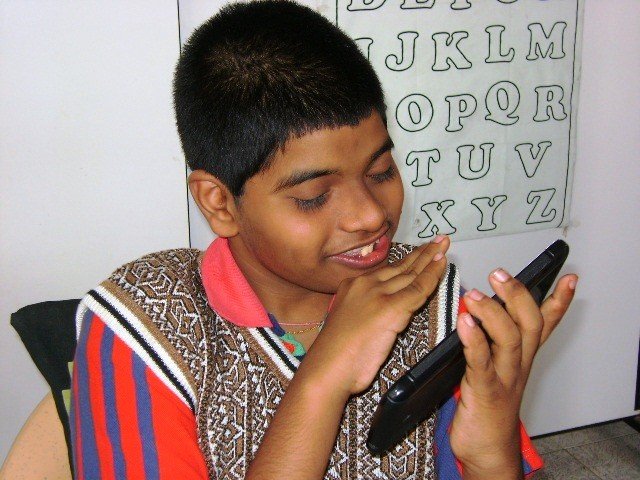
Roshan (name changed) was dozing when the teacher came around to his end of the table. Pale winter light filtered in through the grated classroom window, and the warm room filled softly with jazz. It was left to his caregiver to wake him up from his mid-morning nap. She shined a small flashlight back and forth on his face like an optholmologist doing eye check and called his name. Then she put her hand on his cheek and gently rubbed it as he focused his eyes.
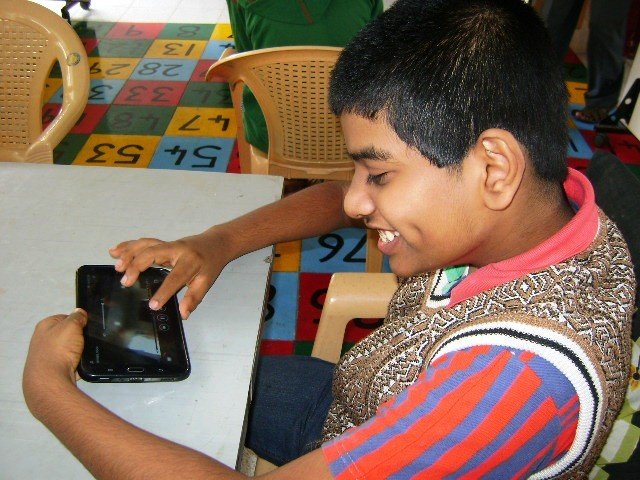
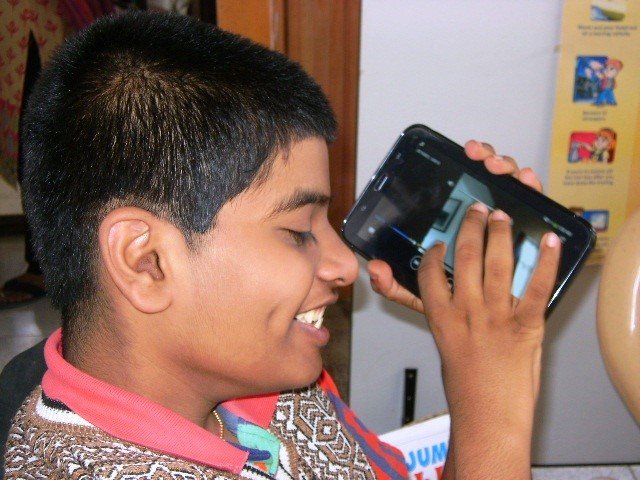
The caregiver, Anitha (name changed), placed an I-pad against Roshan’s left ear, and tuned it in so he could hear the music. “Roshan, Thomas and friends are waiting for you,” she said. She watched Roshan’s eyes and face for a sign he had understood, a smile, nod, a noise. He gently took hold of the I-pad and pulled it away from her hand. He was now ready to take on the world.
At a time when his peers are enrolled in college or earning money at jobs, Roshan, a handsome 17-year-old with a sliver of a mustache, is still in a respite centre, being taught the most basic of facts. Since he is speech impaired his vocabulary is limited to responding to instructions : play music, reduce volume, change channel.
And yet, because of his cognitive and intellectual disabilities and brought on by a traumatic birth and asphyxia it is almost impossible to know what he comprehends and retains. After 17 years at Balajothi Centre for the Disabled he is less reserved and more social, but otherwise has shown almost no progress, his parents said.
Once predominantly isolated in institutions, severely disabled students have been guaranteed a free, appropriate public education like all children since the recent and increasing advocacy of inclusive education. In the years since, schools across the country have struggled to find a balance between instruction in functional skills and academics while providing basic custodial care.
Roshan is part of a fraction of a fraction, classified as having “multiple disabilities,” a broad category under the Persons with Disabilities (Equal opportunities, Protection of Rights and Full Participation) Act, 1995 that refers to children with disabilities and severe educational needs.
Students with multiple disabilities, like Roshan and his schoolmates, can have a wide range of diagnoses, including cerebral palsy, rare genetic disorders and problems that stem from conditions in-utero or at birth, some of which have no name.
For many of these students, the post-school future holds day residential programs, nursing facilities or group homes, not college or jobs. The concepts of educational reform and standardized assessment have little meaning for them; they are among the most costly to educate and the least understood.
Roshan recognizes familiar voices and can sense their care and affection. He communicates some needs: at lunch, he pulls the empty plate towards him and pushes the hand of his caregiver to bring more of his favorite dish, if he is in the mood. If that is not the case Roshan is one of the most difficult children to feed as he has an intense dislike to food. When happy, he claps his hands and jumps up and down to show his excitement or hugs the person nearest to him.
But he cannot walk, does not speak and cannot feed himself or see much beyond shapes and shadows. On standardized assessments, he has trouble with tasks most children master in infancy, like opening and closing his eyes on command. Occupied much of the time by his own inner world, he does not respond consistently to his own name.
School system or not, educating Roshan remains a search for ways to reach him !!
Balajothi is grateful to you for your generous contribution in support of Roshan and several other similar children with intellectual disability. Thank you for your continuing generosity.
J M Balaraj
Project leader
Project reports on GlobalGiving are posted directly to globalgiving.org by Project Leaders as they are completed, generally every 3-4 months. To protect the integrity of these documents, GlobalGiving does not alter them; therefore you may find some language or formatting issues.
If you donate to this project or have donated to this project, you can receive an email when this project posts a report. You can also subscribe for reports without donating.



Support this important cause by creating a personalized fundraising page.
Start a Fundraiser