By Jorge Recharte | President, Instituto de Montana
7 Communities Respond to Glacier Loss in Peru
1st Quarterly Report November 1 - December 30, 2021
We are pleased to report on the initial two months of activities of our GlobalGiving project “7 Communities Respond to Glacier Loss in Peru”. Following our first fund raising campaign in September, we were able to raise 30% of the target funds and start field activities in November 2021. We have initiated the following activities for each of the three objectives established for the project.
The seven communities that we have identified to intervene in this phase of the project are located two in Ancash and 5 in the highlands of Lima. We have implemented initial activities in three of seven communities during the first two months of project activity. The cooperative approach we follow at Instituto de Montaña to implement projects with mountain communities is grounded on a participatory process to make sure that problems and solutions are owned by those communities. Instituto de Montaña plays the role of facilitator to identify and design specific interventions
1. Seven wetlands, silt dams and/or infiltration ditches restored using indigenous knowledge to secure water supply and offset loss of glaciers.
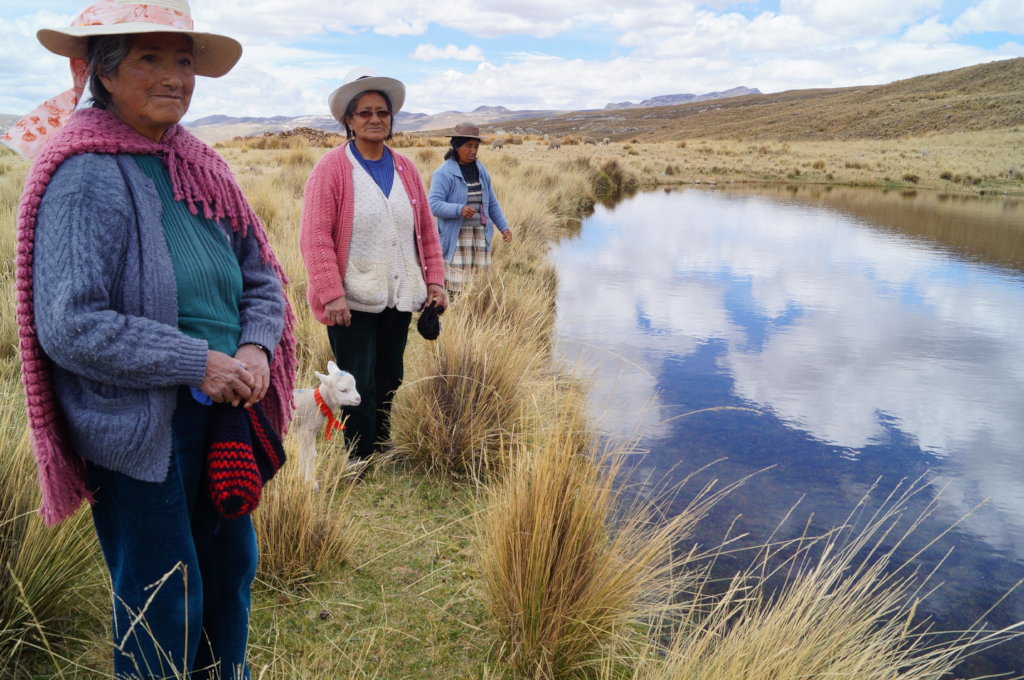
We begun consultation with 2 mountain communities in Ancash, Northern Peru. The communities are Canrey Grande and Cordillera Blanca. We conducted a consultation workshop with 17 representatives of these two communities and also their local governments on November 19. This was followed by visits to interview participants in more detail.
Because the purpose of the project is to support communities´ responses to the loss of glaciers resulting from climate change, we worked with representatives of the communities to identify and prioritize the problems. Residents use the native Quechua language expression “Uchakaquikan, meaning “The finishing of glaciers”. Communities identified two main impacts of climate change connected to the loss of glaciers:
Drought and climate challenges are described by local residents in the following words:
“We are dependent on the irrigation canal throughout the year because rains may come late. The crop that suffers most tan any other crop is alfalfa [for cattle].”
“As the months without rain have extended in recent years, the result is irreparable damage to our crops of potatoes and cereals and also to our cattle because they do not gain weight and we loose.”
While droughts are the problem perceived as most important, the intensity of rains in shorter periods of time is also a serious problem because this prevents water from soaking soils and reaching the underground water table. One resident explained it in this way:
“The weather was more stable before (…) now we have abrupt changes. For example this year we had so much rain that it washed away crops and one part of our [irrigation] canal”
The problem of acid water is described with the expression “agua alcaparrosa”, “redish water”. A woman in the group said that in order to identify solutions to this problem
“We need to sensitize (…) younger people to join the research group for solutions. We need to investigate water canals, sedimentation systems and wetlands”
Other participants agreed on the need to develop sedimentation systems and new wetlands to reduce the metals caused by the loss of glaciers.
The need to work on better management of wetlands, locally known as oconales or bofedales, was also identified and was linked to the idea of rescuing lost traditional knowledge of wetland management.
Community Participants also identified the specific sites where draught and acid rain problems are worst and also preliminary ideas to develop solutions. For example, drought impacts in the lower zone the areas of Qaqapaqui, Milli, Achic, Canray Grande, Cristalyacu could be diminished with irrigation canals. Similarly, the areas most affected by acid water are the areas of Acocancha, Canray Chico, Achic, Pariapata, Canray Grande and the solution would be the development of wetalnds and sedimentation systems. Other sites where identified for the middle nd upper sections of the valley.
This priority setting exercise and the identification of specific places where we need to focus interventions helps us at Instituto de Montaña to make sure that interventions are owned by the communities and thus are more sustainable.
2. Ancestral indigenous knowledge of water management is recognized as a nature-based, cost effective mountain adaptation to climate change.
We sized the opportunity to increase visibility of indigenous knowledge of water management technologies, presenting the experience of the mountain community of Miraflores in the highlands of Lima to nominating its Yanacancha system of traditional alpine dams and canals to the World Monument Funds Watch 2022 List https://www.wmf.org/nominate.
Miraflores is located in the highlands of Lima. The purpose of this nomination is to identify material and non-material cultural heritage that can help humanity respond to the climate change crisis. In cooperation with the community of Miraflores and the Nor-Yauyos Cultural Landscape Protected Area, we presented the Yanacancha system of silt dams and artificial wetlands and canals that provide water to the alpine grasslands of Miraflores.
If selected as a site to be included in the Watch List, the World Monument Fund will work with Instituto de Montaña to increase public awareness of the importance of this cultural heritage as an example of native solutions to the impacts of climate change. If selected, the World Monument Fund will also match funds raised to restore these native technologies in the community of Miraflores and similar sites in Peru. We expect to report to you results of this nomination in the next quarterly report.
3. The RETAMA network of communities has incorporated new members and scales up the solutions to 7 new places.
This is a long-term result that will be a measure of the wider impacts of the initiative. We have no activities or results to report at this early stage of the project. However, we should share with you that through a cooperation with Oxford University, Instituto de Montaña has started to conduct an economic assessment of past restoration efforts in Miraflores community to assess to what extend these type of interventions may contribute to post-Covid-19 economic recovery.
Project reports on GlobalGiving are posted directly to globalgiving.org by Project Leaders as they are completed, generally every 3-4 months. To protect the integrity of these documents, GlobalGiving does not alter them; therefore you may find some language or formatting issues.
If you donate to this project or have donated to this project, you can receive an email when this project posts a report. You can also subscribe for reports without donating.



Support this important cause by creating a personalized fundraising page.
Start a Fundraiser