While people in many parts of the
world are fighting for survival,
humanitarian aid itself is becoming
scarce. On World Humanitarian Day,
the partner organization of Aktion
Deutschland Hilft, LandsAid e. V.,
from Kaufering, Germany, urgently
warns of a dangerous trend:

Humanitarian aid is being
politicized, instrumentalized –
and increasingly underfunded. At
the same time, however, the
suffering in many regions is
dramatically worsening – both in
the eyes of the world and often
behind closed doors.

Gaza: Symbolic Politics Instead of Rescue
The humanitarian situation in Gaza has
reached a new low. Children are starving,
hospitals are shut down, and drinking
water is scarce – while aid packages
are being washed up in the sea. "Aid
measures such as airdrops may seem like
solutions at first glance, but they are
no substitute for well-planned,
coordinated aid deliveries via land
routes," says member of the board of
LandsAid. "Aid supplies that don't arrive
don't save lives."
Most recently, our partner organization
LandsAid has worked with a small, courageous
partner organization on the ground, board
member continued. Their team distributed
urgently needed food and implemented
psychosocial support for traumatized
children and young people. "What they
accomplished is almost beyond words,"
said the LandsAid board member. "But
without access, without resources – and
without outside support – even these
lifesavers reach their limits."

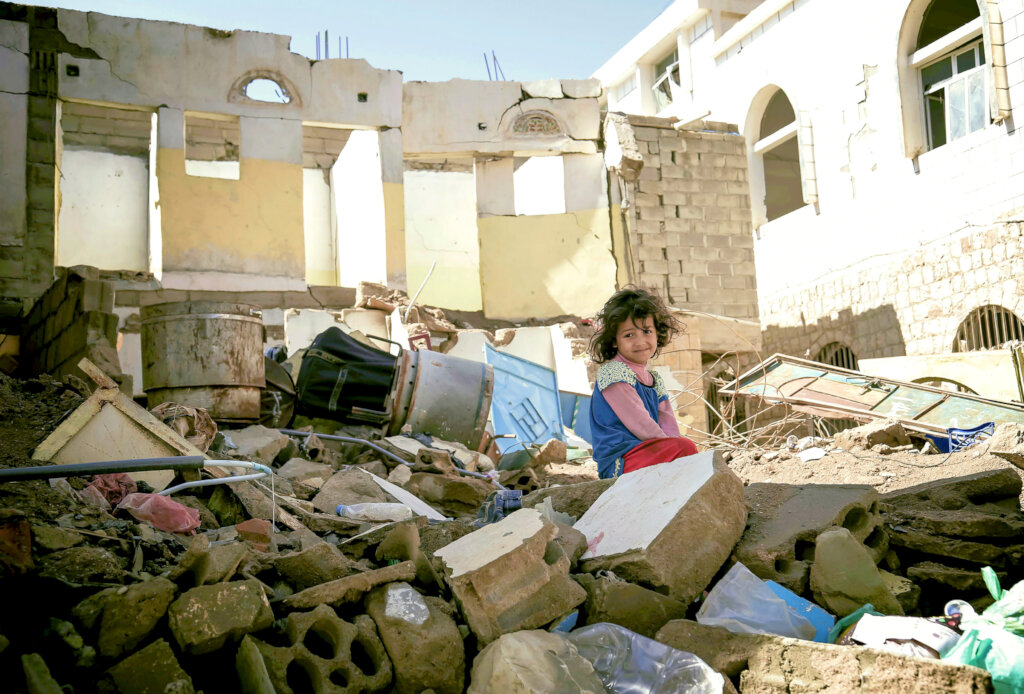
Yemen: A Forgotten Crisis
At the same time, people are dying
every day in Yemen – quietly, unseen,
without comment. Almost 80 percent of
the population depends on humanitarian
aid. Children are starving, families
are fleeing.
The war that has caused all this for
more than ten years seems to have faded
into the background. "Yemen is no less
terrible than Gaza. It's just less
visible. And therefore less funded,"
board member emphasizes.

Cuts to humanitarian aid send "the wrong signal"
The ongoing suffering of people living in
the front-line areas of Ukraine also
threatens to disappear from public view,
while humanitarian needs continue to grow.
As the crises escalate, the German
government is planning massive cuts to
humanitarian aid.

"A wrong signal at the worst possible time,"
says the LandsAid board. Because: "Without
reliable funding, aid will collapse –
precisely where it is most urgently needed."

Unrestricted donations enable flexibility – and save lives
As a non-profit organization, the partner
organization of Aktion Deutschland Hilft,
LandsAid, relies on unrestricted donations
to be able to act quickly, flexibly, and
independently – especially in crisis
regions like Gaza, Yemen, Ukraine, Syria,
and all the other countries where the
organization is active.
"Employee-earmarked project funds help –
but they aren't enough," emphasizes board
member. "Unrestricted donations are the
backbone of our work. They close funding gaps,
enable immediate assistance when there's no
time to process applications, and strengthen
local partners who would otherwise be left
to fend for themselves. In short: they make
long-term structures possible – not just
one-off actions."

LandsAid calls for safe access to people in need.

On World Humanitarian Day, our partner
organization LandsAid says: "Please do not
just talk about aid, but actually help."
What is needed now are not further cuts,
but targeted investments in what truly
matters: the lives, dignity, and safety of
millions of people worldwide.

Forgotten crises must no longer remain in
the shadows – they need attention, resources,
and solidarity. Instead of symbolic gestures,
concrete solutions are needed: safe access to
people in need, reliable humanitarian
corridors, and long-term support.
300 Million People Needed Humanitarian Aid in 2024
August 19th is World Humanitarian Day – an
action day proclaimed by the UN in 2008 and
observed annually ever since. Humanitarian
aid refers to the material and logistical
provision and distribution of resources to
protect people in humanitarian emergencies.
The need for it is constantly growing.

According to UN figures, around 300 million
people worldwide were dependent on humanitarian
aid and protection in 2024 – that's roughly one
in every 27 people globally. This is a slight
decrease compared to 2023, when the figure
was over 339 million.

A Day of Remembrance for All People in Crisis Regions
Despite this decrease, it does not mean that the
situation has improved. Rather, the reduction
results from a stronger prioritization of the
most urgent cases coupled with limited resources.
It is therefore not a genuine decrease in need, but
a refocusing of aid efforts.
It is always the children who suffer most from
violence, hunger, or disease in wars, crises,
conflicts, or natural disasters. This day of
remembrance is dedicated to all the families
who depend on emergency aid and protection. At
the same time, conditions for aid workers are
becoming increasingly difficult.

Aid workers risk their lives every day
These dedicated aid workers often risk their lives
to help people in war-torn and crisis-stricken
regions around the world. The focus of
emergency aid is to save lives and alleviate
suffering while maintaining neutrality and
impartiality. This is what these people are
fighting for. World Humanitarian Day is meant
to honor their tremendous commitment and courage.

The partner organization of Aktion Deutschland
Hilft, LandsAid, also has such admirable people
working for them. Currently, it is the aid teams
of our local partners who are distributing
urgently needed food to the most vulnerable
people, for example in Gaza, Ukraine, and Yemen,
and who are implementing psychosocial support
measures in Ukraine and Syria. "We are thinking
of them and thanking them," says board member.
Unrestricted donations as a vital resource
for international aid
Despite slightly declining numbers, the need for
humanitarian aid remains at a historically high
level. Unrestricted donations are needed more
than ever – to provide assistance where it
should be planned, but where funds are lacking.

Cuts and prioritizations jeopardize aid in crisis
regions such as Gaza, Yemen, and Syria, especially
for vulnerable groups.

Thank you for your donation!
![Share on Twitter]()
![Share on Facebook]()