By Huzaifa Kermani | Chief Marketing Officer (CMO)
More Than a Meal: Nourishing 1,850 Children — and the Evidence Behind Why It Matters
By Huzaifa Kermani | Chief Marketing Officer, NUR–Fatima Memorial System
April 20, 2026
Dear Friends and Supporters,
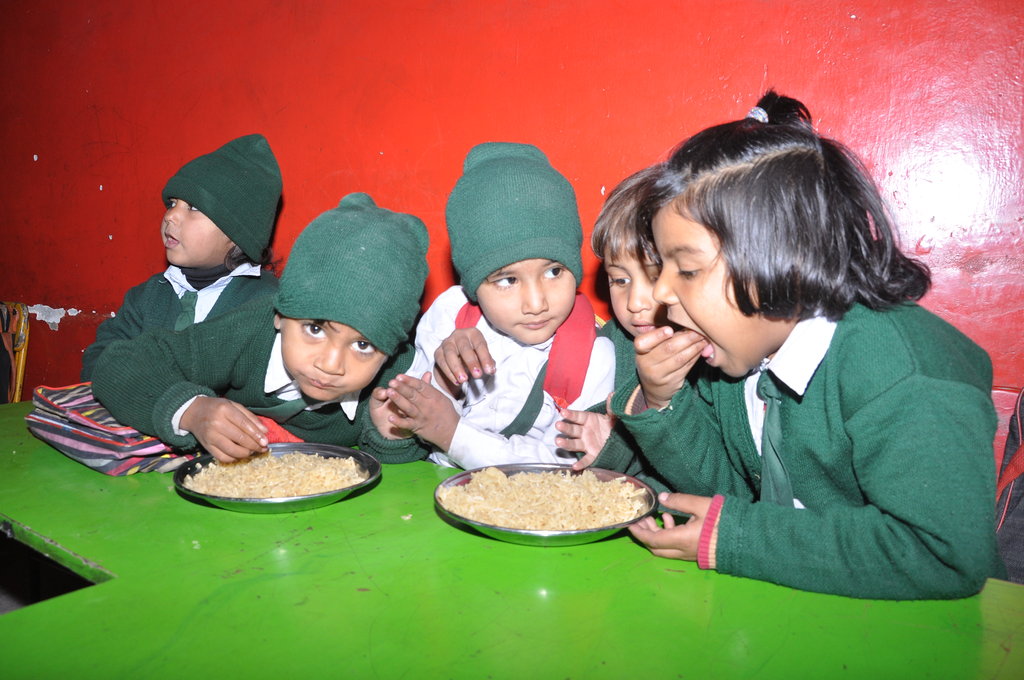
Every school morning across seven peri-urban communities on the outskirts of Lahore, 1,850 children walk into a NUR Foundation school. Many of them left home without breakfast. Some come from households where a single meal a day is the norm, not the exception. For these children, what happens in the first hours of the school day — whether they can concentrate, whether they stay, whether they come back tomorrow — depends in no small part on whether they are fed.
This project exists to answer that need. With your support, the NUR Food Bank provides weekly meals to every child enrolled in our community schools. This report updates you on where we stand, what the national evidence tells us about why this work is so critical, and what your continued support makes possible.
About the NUR Foundation Schools and the NUR Food Bank
The NUR Community Outreach Programme (NCOP) was established in 1985 with a founding mission: to work towards poverty alleviation by creating access to better education, health, and economic development. Today, NCOP operates across seven peri-urban communities in Lahore, running a network of formal and non-formal schools that together serve 1,850 underprivileged students.
These are children whose families cannot afford private schooling, whose neighbourhoods are underserved by government institutions, and whose daily lives are marked by economic precarity. Education at a NUR Foundation school is entirely free — tuition, books, and uniforms included. The NUR Food Bank adds the one dimension that makes that education possible: nutrition.
Currently, meals are provided once a week to all enrolled students. Our goal — the reason this project exists on GlobalGiving — is to move towards daily meals, which the evidence overwhelmingly shows is the threshold at which school feeding programmes begin to produce lasting change in attendance, health, and learning outcomes.
The National Crisis This Project Responds To
Pakistan is in the midst of a child nutrition emergency, and the data demands that we say so plainly.
Key Statistics on Child Hunger and Malnutrition in Pakistan
The communities we serve — peri-urban Lahore — sit squarely within this crisis. Families in these settlements live on fragile, irregular incomes. Food insecurity is not an abstract statistic: it is the reason children arrive at school unable to concentrate, the reason they miss days when circumstances worsen, and the reason some stop coming altogether.
What School Meals Actually Do: The Evidence
This is not a peripheral welfare measure. The research on school feeding programmes in Pakistan and globally is consistent and compelling:
In June 2025, Pakistan’s Prime Minister personally convened a national consultation on school meals, stating: “With 25 million children out of school and many enrolled students struggling to learn due to hunger and malnutrition, the reality demands urgent action.” Pakistan signed the Global School Meals Coalition commitment in 2021, pledging to ensure every child has access to healthy, nutritious food at school by 2030. The NUR Food Bank is part of that commitment — delivered at the community level, today.
Where We Stand: Funding Gap and Immediate Need
Our 1,850 students currently receive one nutritious meal per week through the NUR Food Bank. Each weekly meal for the full student body costs $1,850. To move to daily provision — the standard that produces the outcomes described above — we need sustained donor support at a scale we have not yet reached.
Food inflation in Pakistan has compounded the challenge. Over the past two years, food prices have risen sharply, and the purchasing power of our operational budget has contracted. The cost of maintaining even the current weekly schedule has increased, and the gap between current provision and daily provision has widened.
Every dollar raised through this project goes directly to food for children — no overhead, no diversion. It is one of the most direct, tangible acts of impact available to a donor anywhere in the world.
How Your Donation Feeds a Child
What the Next Phase Will Deliver
With sufficient funding, our next phase targets:
A Word from the Community
“Before, my son would come home saying he couldn’t concentrate. He was always tired. Since the school started giving meals, he comes home talking about his lessons. He’s doing better. We are grateful beyond words.”
— Mother of a student, NUR Foundation School, Lahore — 2026
“These children do not come from homes where breakfast is guaranteed. When we feed them, you can see it immediately — they sit up, they pay attention, they participate. Hunger is invisible to everyone except the teacher who watches it every day.”
— Teacher, NUR Foundation School, NCOP network
A Final Appeal
The NUR Foundation has been educating the children of Lahore’s underserved communities since 1985 — over four decades of uninterrupted service. The NUR Food Bank is the programme’s acknowledgement that education and nutrition are inseparable: you cannot ask a hungry child to learn.
Pakistan’s government has committed, at the highest level, to ensuring school meals for every child by 2030. We are already doing it. We have been doing it. What we need is your support to do more of it, more often, for the 1,850 children whose futures depend on showing up — and being fed when they do.
Please donate today. Share this project with someone who can. And if you are able, please consider setting up a monthly contribution — the single most powerful thing a donor can do for a programme like this.
Restore attention. Restore attendance. Restore the future.
Thank you for standing with our children.
Huzaifa Kermani
Chief Marketing Officer
NUR–Fatima Memorial System | Fatima Memorial Hospital, Lahore
Research References:
Global Hunger Index. Pakistan country profile, 2025. globalhungerindex.org
World Food Programme. Pakistan country page, 2024. wfp.org/countries/pakistan
UNICEF Pakistan. Nutrition overview. unicef.org/pakistan/nutrition-0
Khan DS et al. “Nutritional Status and Dietary Intake of School-Age Children and Early Adolescents.” PMC / Systematic Review, 2022.
Tawana Pakistan Project. School nutrition programme evaluation. Sindh Province, 2003–05. ResearchGate.
WFP. “School meals take centre stage in Pakistan.” National consultation, June 2025. wfp.org
Arab News. “Islamabad school meals programme sees attendance surge.” October 2025.
Allah Walay Trust. School Meal Programme outcomes. allahwalaytrust.org.pk, 2025.
Express Tribune / WFP. “The many benefits of a school meals programme.” May 2022.
By Huzaifa Kermani | Chief Marketing Officer (CMO)
By Huzaifa Kermani | Chief Marketing Officer (CMO)
Project reports on GlobalGiving are posted directly to globalgiving.org by Project Leaders as they are completed, generally every 3-4 months. To protect the integrity of these documents, GlobalGiving does not alter them; therefore you may find some language or formatting issues.
If you donate to this project or have donated to this project, you can receive an email when this project posts a report. You can also subscribe for reports without donating.



Support this important cause by creating a personalized fundraising page.
Start a Fundraiser





